Nowadays, Engineering and manufacturing projects are much more complex. You’ve got tighter deadlines, more compliance steps, and customers who want the work built exactly to spec… all delivered sooner than they would have accepted last year.
Most firms have handled that on the delivery side. They’ve invested in better tooling, tighter processes, and more capable engineers. But deciding who works on what hasn’t moved at the same speed.
We looked recently at why spreadsheets struggle to keep up with resource planning for manufacturing and engineering firms. There’s also a deeper issue at play: project complexity has outpaced the way you plan teams.
Read on to find out more or book a demo to see how Retain brings projects, people and capacity into one view.
Where resourcing decisions fail in complex engineering and manufacturing projects
When a firm runs a handful of simpler projects, planning by memory works. Someone knows who’s free, who’s good at what, and roughly when the current jobs finish. In an ideal world, you can hold the whole thing in your head.
But most project managers now run between 2 and 5 projects at once, and engineering and manufacturing firms don’t stop there. Add maintenance, new product introduction, customer orders, compliance work and continuous improvement… and the same people get pulled across all of it!
Essentially, what worked at 5 projects stalls at 15, and usually no one can point to the day it happened.
When resource planning breaks down, three things tend to show up first:
- Planning moves to named roles instead of named people, because tracking individuals by hand is too much work. “We need a senior mechanical engineer” hides whether the two you have are already booked.
- Managers over-book to protect their own delivery. Time gets blocked that may never be used, and real capacity disappears from view.
- The honest answer to “can we take on this job in March?” becomes a round of phone calls rather than something anyone can see.
That last one comes up constantly when we talk to engineering and manufacturing firms. The version we hear most: we can’t confidently say whether we have room for new work, so everything is an educated guess.
The hidden costs of inefficient resource planning
With so much to keep on top of, it’s no wonder the symptoms are easy to feel and harder to trace. Here’s what teams describe, and what’s usually behind it.
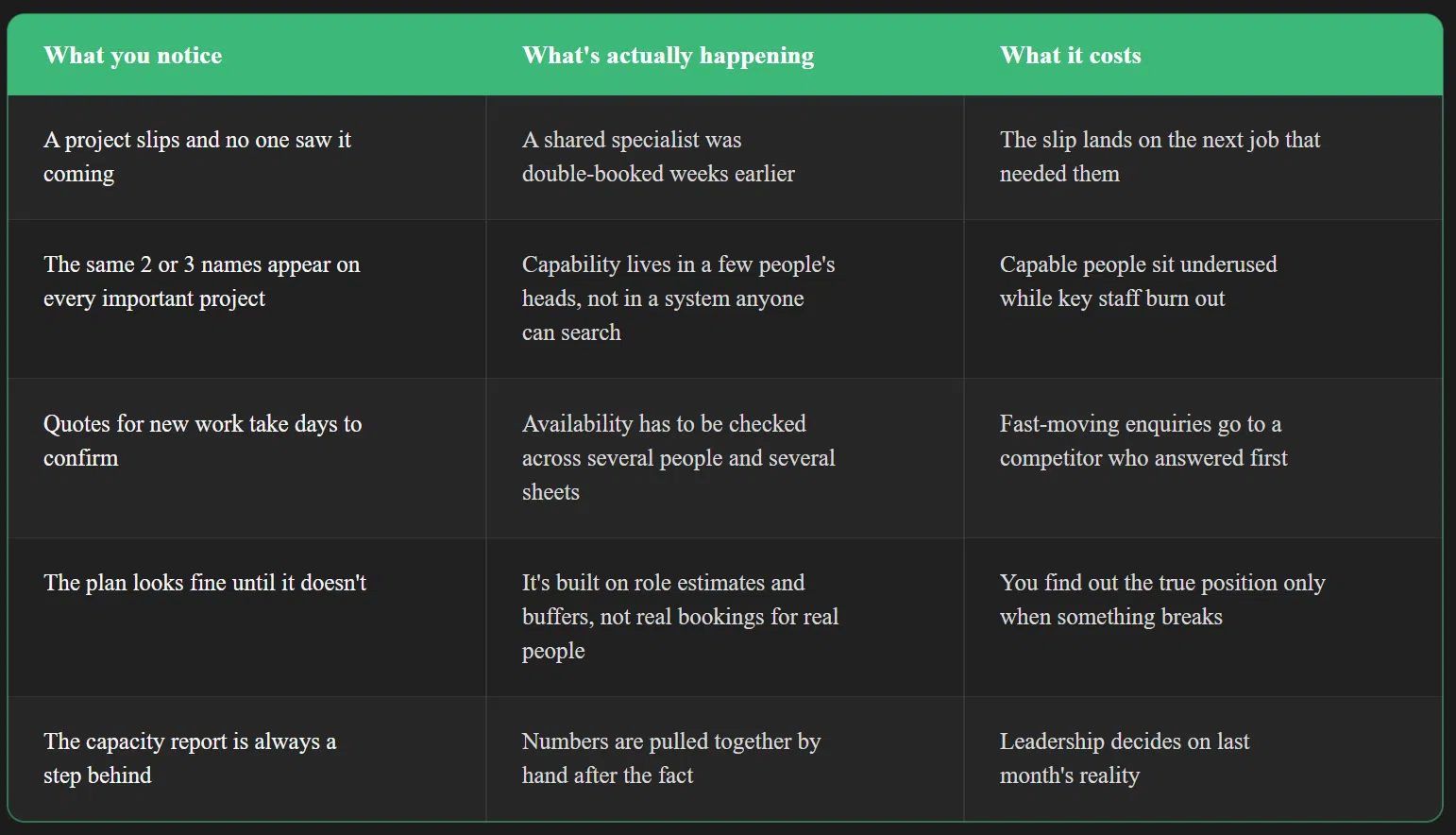
Essentially, this is what happens when project complexity climbs while the planning method stays still.
There are a few ways this process can be streamlined. Take Retain Cloud for example. It includes features such as:
- A single shared view of every project, person and booking, so checking who’s free is a quick search instead of a round of calls.
- Conflict indicators and availability heatmaps that flag a clash while you can still do something about it, rather than after a project has slipped.
- AI suitability matching and People Finder that find the best available person for a job in seconds, based on real skills and availability.
See for yourself how Retain eradicates numerous time-consuming tasks like chasing availability across spreadsheets and rebuilding capacity reports by hand, and allows for faster, more confident decisions about the work you can take on.
How one reassignment ripples through everything
Here’s the part that hurts margin, and the part most planning tools never show.
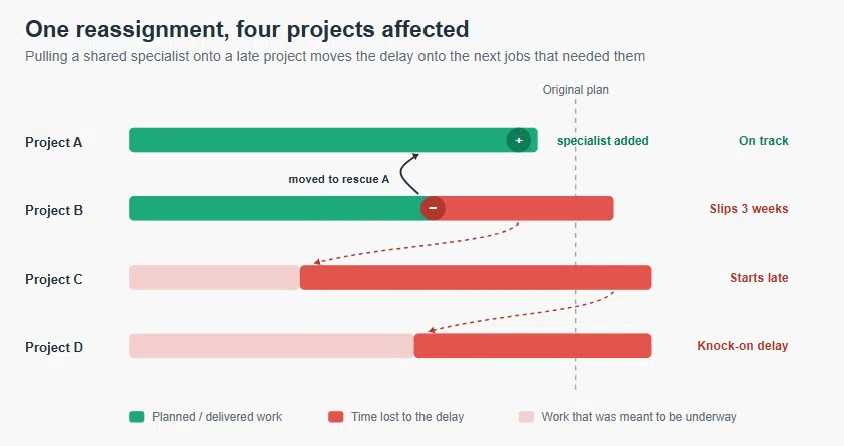
A specialist is needed on Project A, which is running behind. The obvious move is to pull them off Project B for a fortnight. Project A recovers. Project B now slips. And Project B was feeding Project C, which can’t start its next stage without B’s output, so C slips too. Project D, which shared a resource with C, moves as well.
One sensible decision, made with the information in front of you, ended up affecting four projects. The resulting chain of events is where the cost lands, and it never shows on the schedule where you made the call.
This is well documented. Across more than 16,000 large projects in Bent Flyvbjerg’s database, only 8.5% finish on time and on budget, and the average cost overrun is 62%. Those figures are sharpest on megaprojects, but the mechanism is the same at any size: shared resources mean delays get inherited by the next project in line. Flyvbjerg’s own conclusion is that planning is the cheapest insurance a project has, and the part most firms underfund.
The reason the chain stays invisible is simple. When you look at Project B on its own sheet, the reassignment looks fine. You can’t see, on that sheet, that the same change just pushed C and D. That cross-project blindness is what turns a reasonable trade-off into a portfolio problem.

How to tell if resource planning has fallen behind your projects (a quick checklist)
We’ve already touched on how resource planning falls behind, but here’s a quick self-check. If you recognise more than 3 of these, complexity has overtaken your method.
- You can’t answer “can we start this project next month?” without phoning round.
- The same few people are on every job that counts.
- You learn about over-allocation after a project is already at risk.
- New quotes wait on someone manually checking availability.
- Your forward view past about 6 weeks is mostly guesswork.
- Two managers both think they have the same engineer next week.
- Your capacity report gets rebuilt in a spreadsheet the night before the meeting.
- Weekly planning meetings that are time-intensive and place additional strain on already stretched resources.
These are the things buyers raise with us most often. Instead of coming to us saying “we need software,” they say “we want to move quickly, and we can’t.”
Why speed to resource is a competitive advantage
Suffice to say, you can’t hire your way out of this. The labour side is tighter than ever.
About 36% of manufacturing vacancies are hard to fill because candidates lack the right skills, against a 24% average across all industries. Around 76% of engineering companies say they struggle to recruit skilled staff. Manufacturing engineering roles now take roughly 47% longer to fill than the UK average, and an ageing workforce makes it worse, with about 20% of UK engineers due to retire by 2026.
The firms pulling ahead mobilise the right people faster from the team they already have. When you can answer a client in an hour instead of three days, you win the work that moves quickly. When you can see spare capacity that was hidden, you take on more without hiring. This kind of speed shows up directly in how many projects you finish and what margin survives.
By using and integrating the right software, these processes can be streamlined significantly.
What helps: Resource planning software for engineering and manufacturing
Most engineering and manufacturing firms have had their fill of rigid processes. What changes the position is being able to see and act on real capacity in one place, without piling on admin.
A few things make the biggest difference.
#1. One shared view of people, projects, skills and capacity
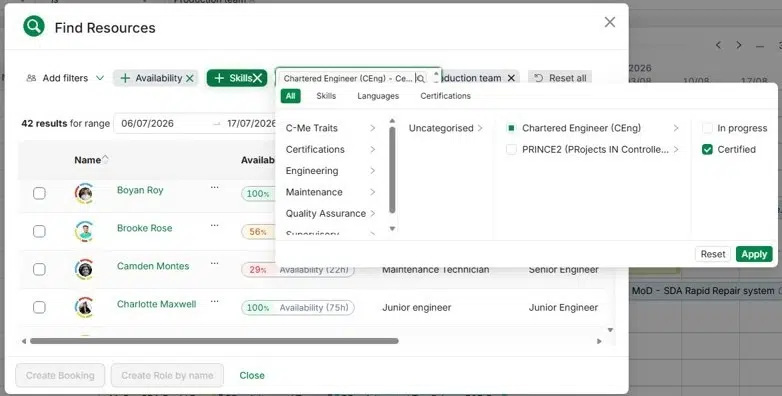
When everyone works from the same information, decisions stop depending on who you ask. Retain brings projects, bookings, skills and availability together, so “who’s free and good for this?” is a search, not a meeting.
#2. Planning by real people and real skills, not role buckets
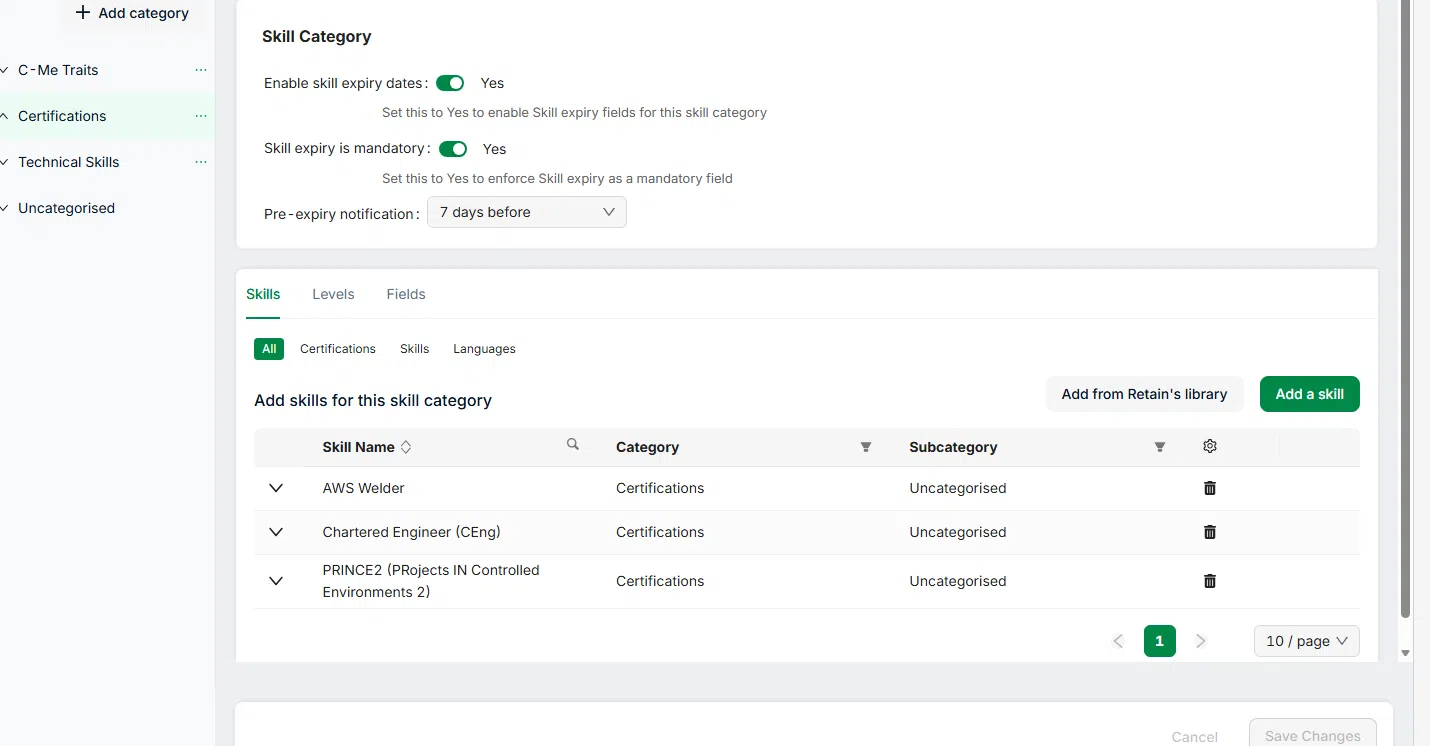
A standardised skills profile lets you match work to the person who can actually do it, and see where the genuine shortage is before a project starts.
#3. Conflicts visible before they happen
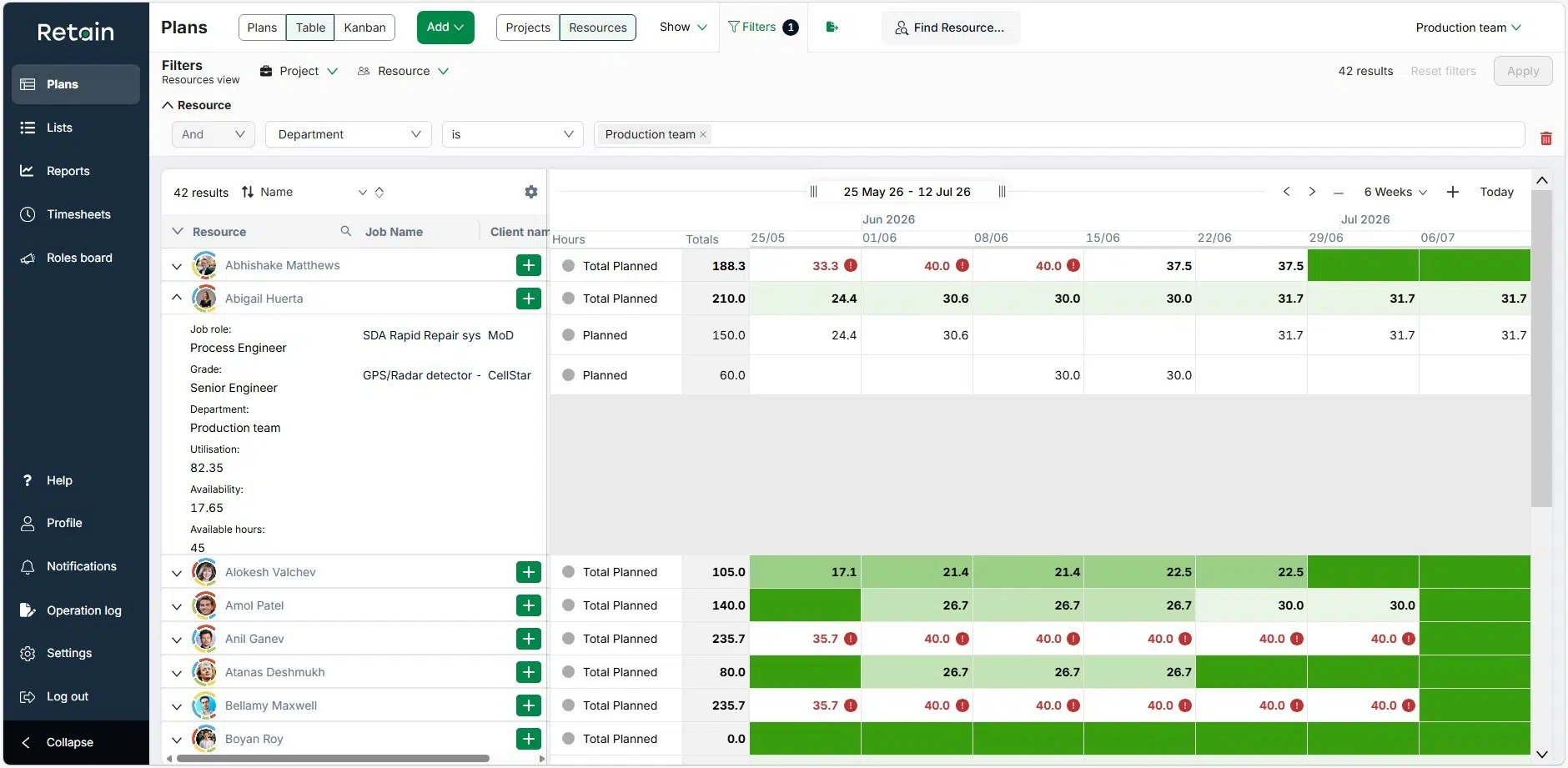
Availability heatmaps and conflict indicators show the double-booking while you can still do something about it, not after Project B has already slipped.
#4. Faster mobilising
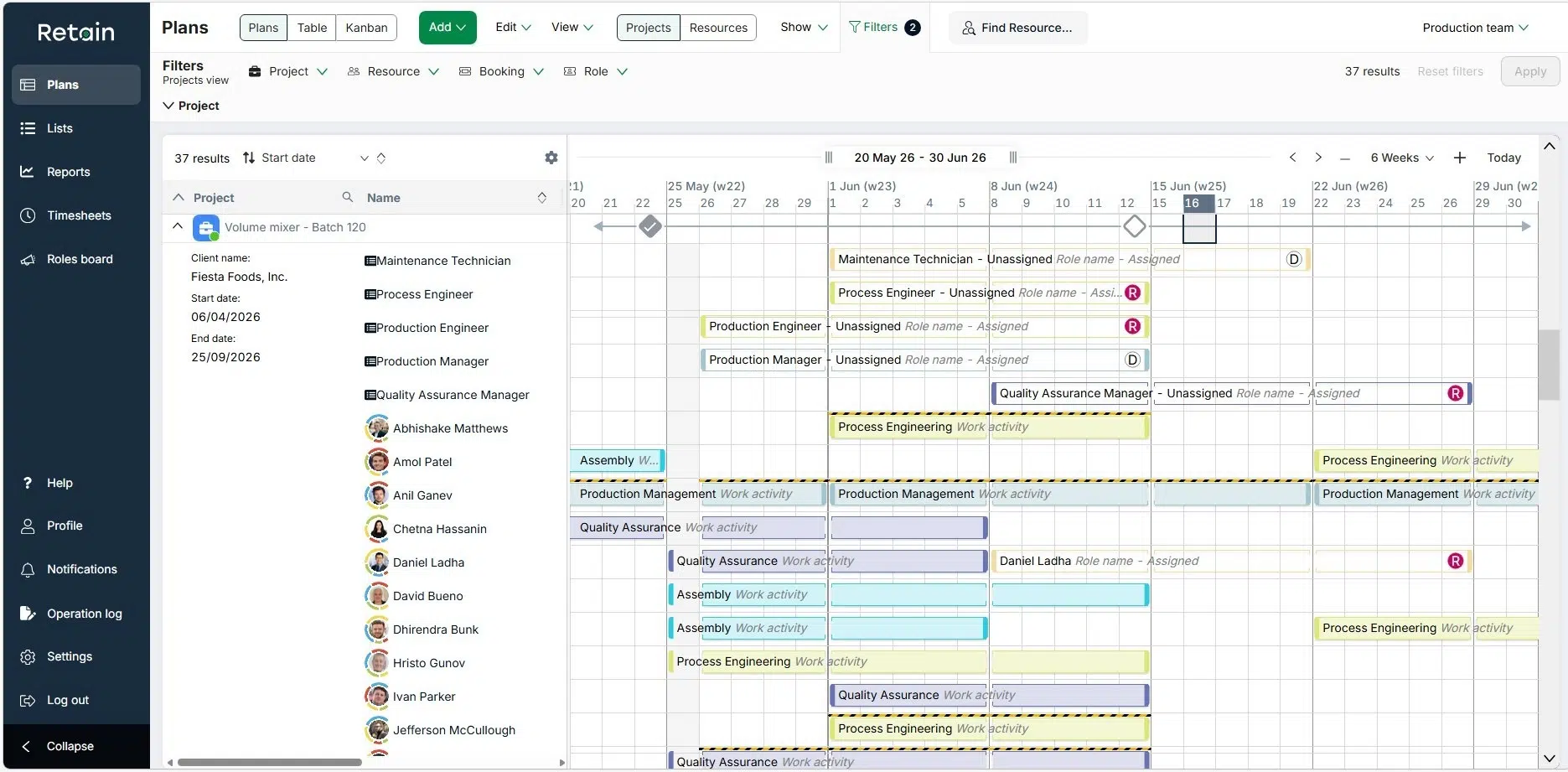
People Finder and AI suitability matching show the best available person in seconds, with a manual override for when you know better than the system. For short, overlapping work, the Kanban view in Retain Cloud tracks who’s doing what each day.
#5. Reporting that keeps up
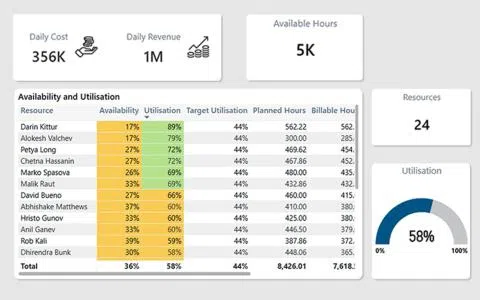
Live dashboards mean leadership sees the current position, not a hand-built version of last month.
None of this removes complexity from your projects. It stops that complexity from being absorbed, badly, by a planning method built for simpler work.
Related reading: Resource planning for engineering firms: A buyer’s guide
Where to start
If this all sounds familiar, the useful next step is seeing your own portfolio in one view, with the conflicts and spare capacity you can’t currently see.
👉 Book a demo to see how Retain helps engineering and manufacturing firms plan people across concurrent projects, and answer “can we take this on?” with confidence.
Our editorial process
Written from interviews with resource managers in IT consulting firms, alongside anonymised patterns from Retain customer data. Direct quotes are used with permission and lightly edited for length.
Reviewed for accuracy by Retain’s resource management practice leads before publication. Claims about outcomes are checked against source data or removed.
The summary at the top of this page is generated from the article text. The article itself is written and edited by people. AI is not used to draft claims, quotes or data.
Spotted something wrong? Email editorial@retaininternational.com and we will correct it, noting the change at the foot of the article.