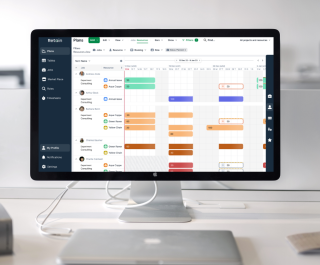
Somewhere between 1,000 and 10,000 people, resource planning starts to really strain. Without strong workforce visibility, leaders lose a reliable view of who’s available, what skills exist across the business, and how much capacity there is. Decisions are taking longer, involving more stakeholders, and carrying more risk.
We’ve already seen what happens at the extreme end of the scale when we interviewed former Capgemini resource planner Farhad Pezeshgi, who coordinated hundreds of thousands of employees across markets, systems, and time zones.
But long before that point, control becomes harder to maintain. Because as your organisation grows, visibility doesn’t scale automatically. It needs to be built, structured, and actively managed.
Let’s take a look at where things begin to break and how leading firms are staying ahead of it.
Challenge #1: You lack workforce visibility
The data exists. It’s just scattered. Skills are tracked in one place. Availability in another. Project demand somewhere else entirely. Local teams build their own workarounds. Spreadsheets fill the gaps. And over time, every department ends up working from its own version of reality.
You can see the issue here.
Even when the information is technically there, it’s hard to bring it together quickly enough to support real decisions.
That creates challenges:
- People get staffed based on familiarity, not capability
- Known high performers get overused, while others are overlooked
- Cross-region staffing becomes rare, even when the talent exists
- Decisions slow down because teams don’t fully trust the data
We’ve seen how this plays out at scale. In large implementations, teams were turning down work due to perceived shortages, while suitable resources were available just a few miles away. And once these challenges set in, it’s hard to reverse.
Challenge #2: Fragmented systems slow everything down
Over time, most organisations have built their resource planning ecosystem in layers. A scheduling tool here. An HR platform there. Finance system tracking project codes. CRM holding pipeline data. Then a few spreadsheets to stitch it all together.
As a result, planning becomes slower and more manual than it should be.
You’ll tend to see:
- Duplicate data entry across systems
- Lag between updates and actual availability
- Heavy reliance on offline workarounds
- Reporting that takes days instead of minutes
Meanwhile, teams fall back on conversations and local knowledge to fill the gaps.
Challenge #3: Forecasting is often guesswork
Planning ahead should be one of the biggest advantages of scale. More data. More visibility. Better predictions. In reality, the opposite often happens. Because resource forecasting depends on having a consistent view of three things: demand, capacity, and skills. And as we’ve seen, those aren’t all in one place.
So instead, teams piece together a forward view using partial data. This tends to be pipeline information from sales, current allocations from planning tools, skills data from HR, then a layer of assumptions to connect it all.
The problem with that is that a delayed project, a change in scope, or a sudden spike in demand can throw everything off. And without a clear, shared view of resource capacity, it’s hard to adjust quickly.
Here’s what that leads to:
- Key individuals getting overbooked while capacity exists elsewhere
- Bench time building in pockets of the business
- Last-minute reshuffling to fill roles
- Limited confidence in forward plans
What “true workforce visibility” actually looks like
Let’s take a look at what leading firms are aiming for. Because “visibility” gets talked about a lot. It sounds simple. In reality, it’s very specific. At its best, it gives you a live, shared view of your workforce across the entire business, not just within teams or regions, but everywhere.
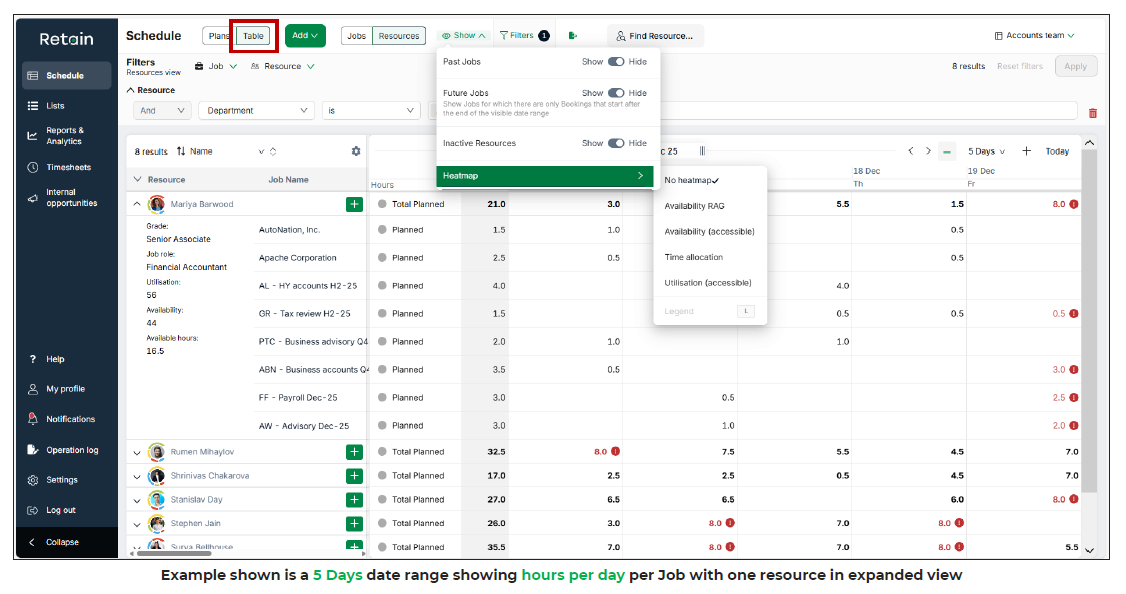
That means being able to answer, quickly and confidently:
- Who is available right now and in the weeks ahead
- What skills exist across the organisation, and how strong they are
- Where utilisation is high, and where capacity is sitting unused
- What demand is coming, and how it maps to real capability
In other words, you move from assembling information to acting on it.
Resource managers can search for skills across the whole organisation, not just their immediate network. Leadership can see how capacity is distributed globally, without waiting for reports. Teams can plan ahead with a clearer understanding of what’s actually possible.
And importantly, decisions start to feel more consistent.
Because everyone is working from the same foundation.
In fact, one of the biggest changes we’re seeing is how firms are structuring skills data. Moving away from inconsistent definitions and towards a shared taxonomy makes it far easier to search, compare, and plan across departments.
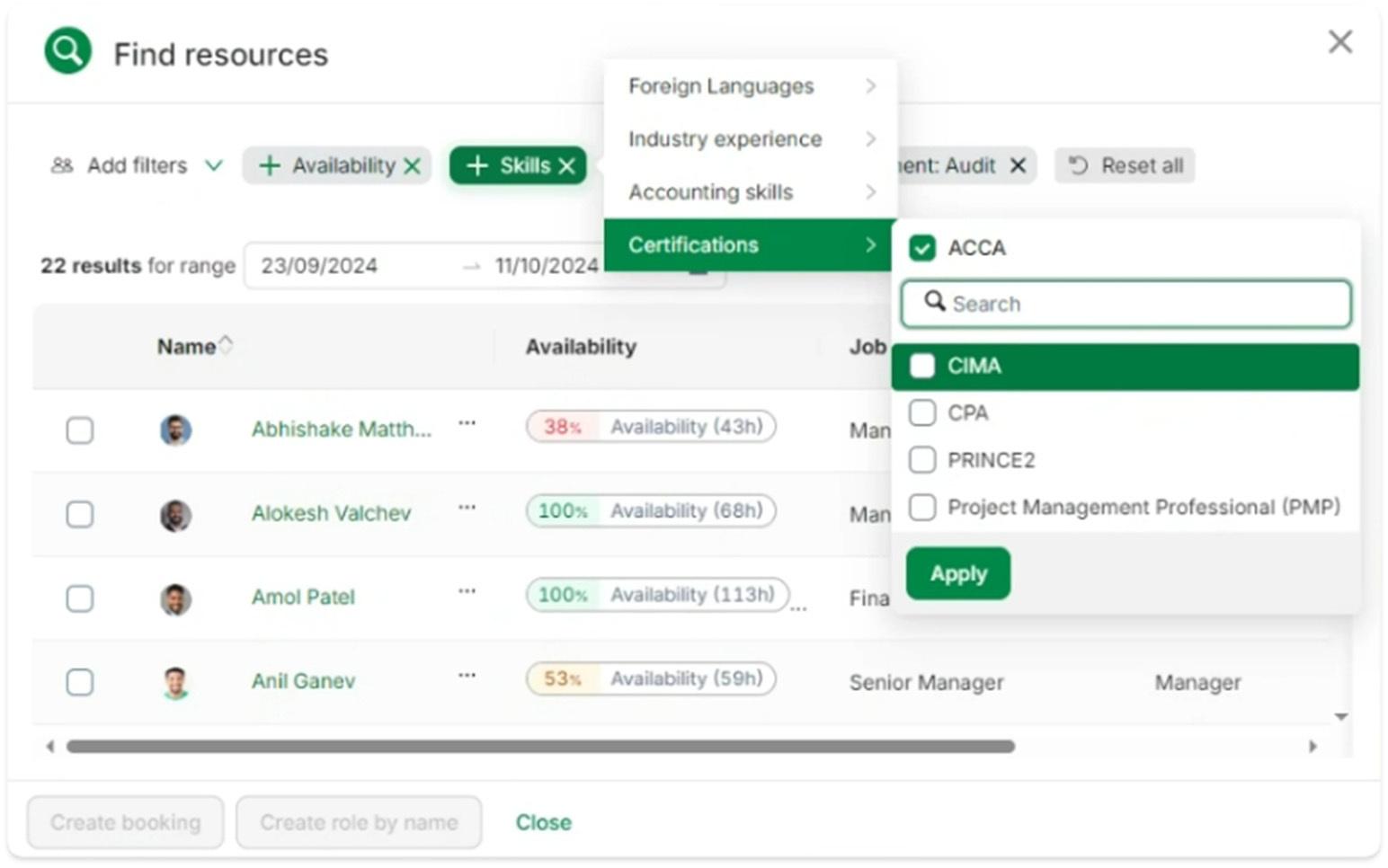
That consistency is what allows visibility to scale. Without it, even the best tools struggle to give a reliable view. With it, planning becomes faster, more accurate, and far easier to manage as the organisation grows.
How unified platforms bring everything together
Leading firms are moving towards unified platforms, like Retain, that bring skills, scheduling, and demand into one place, creating a shared foundation for planning across the business.
In other words, instead of pulling data together manually, the system does it for you.
Here’s what that unlocks:
- A single, consistent view of skills, availability, and demand
- Real-time updates, rather than delayed reporting cycles
- The ability to search and match talent across the entire organisation
- Planning that connects directly to financials, projects, and pipeline data
Resource managers spend less time validating data and more time making decisions. Leadership gets faster access to reliable insights. And teams can collaborate across regions without relying on informal networks.
As a result, admin workload drops and planning becomes far more responsive. And the numbers back it up. Firms using unified platforms like Retain Cloud report reduced manual effort, faster decision-making, and measurable improvements in utilisation.
What changes with workforce visibility?
Once everything is connected, planning becomes less about chasing information and more about making decisions.
Take resource managers, for example. Instead of checking multiple systems and validating data, they can search across the organisation in seconds. Skills, availability, past project experience — all in one place. The shortlist comes together faster, and with more confidence behind it.
Leadership feels it too.
Instead of waiting on reports or second-guessing the numbers, they can see how capacity is distributed across teams and regions in real time. That makes it easier to prioritise work, rebalance teams, and respond to changes without delay.
Here are two examples.
First, cross-region staffing. When visibility improves, it becomes far easier to identify available talent outside local teams. Work gets staffed based on capability, not proximity or familiarity.
Second, utilisation. With a clearer view of capacity, it’s easier to spot where people are overbooked and where time is sitting unused. That allows for quicker adjustments and more consistent performance across the business.
As Farhad explained in his blog, one of the biggest benefits in large-scale implementations was improved collaboration between teams — resource managers could see and respond to challenges across different parts of the organisation, rather than operating in isolation .
The result?
- Faster, more confident staffing decisions
- Better use of available talent
- Less reliance on manual workarounds
- Stronger alignment between teams
And importantly, a major change in how planning is approached.
It becomes proactive rather than reactive.

5 steps to bring workforce visibility and control back
So, how do you move from fragmented planning to something more structured and reliable? The firms getting this right are taking a series of deliberate steps to connect data, align teams, and simplify how planning works.
Here’s where to start:
1. Centralise your skills data
Everything builds from here. Create a consistent way to define and track skills across the business. Same language, same structure, shared across departments. This makes it far easier to search for capability, compare talent, and plan with confidence.
2. Connect your core systems
Planning doesn’t sit in isolation. You need your resource planning, HR, finance, and CRM systems working together. That means shared data, consistent identifiers (like project codes), and fewer manual handoffs. The goal is simple: one flow of information, not multiple versions.
3. Standardise how teams plan
Different departments will always have different needs. That’s fine. What matters is having a consistent foundation with shared processes, aligned definitions, and a common way of working across regions. Without that, visibility breaks down quickly as you scale.
4. Invest in real-time data
Lag is one of the biggest hidden issues in resource planning. If your data is hours or days out of date, decisions will always be slightly off. Real-time or near real-time updates give teams the confidence to act quickly, without second-guessing what they’re seeing.
5. Focus on adoption
This is the one that gets overlooked. You can implement the best platform in the world, but if teams don’t trust it or use it consistently, the benefits won’t show up. That means training, clear ownership, and ongoing support.
Once this is in place, planning starts to feel a lot more controlled, even as the organisation continues to grow.
Control doesn’t scale by accident
Growth brings complexity. That’s a given. More people, more projects, more moving parts. But what separates firms that handle it well from those that struggle is how they manage visibility as they scale.
Because without a clear, connected view of your workforce, planning slows down, decisions become harder, and opportunities start to slip through the cracks.
We’ve seen where things begin to break; fragmented systems, limited visibility, unreliable forecasting.
We’ve also seen what works.
Bringing data together. Structuring skills properly. Connecting planning across departments. Giving teams a shared foundation to work from.
That’s what allows control to scale alongside the business.
So if you’re looking at your current setup and thinking it’s getting harder to manage, you’re probably right.
The next step is making it easier.
Start by connecting your data, aligning your teams, and building a clearer view of your workforce. From there, everything else moves faster.
If you’re still relying on disconnected systems and partial visibility, start by bringing your data together, aligning your teams, and building a clearer view of your workforce.
Want to see how leading firms are doing this in real terms? Explore how Retain Cloud supports unified, skills-led resource planning at scale.
Our editorial process
Written from interviews with resource managers in IT consulting firms, alongside anonymised patterns from Retain customer data. Direct quotes are used with permission and lightly edited for length.
Reviewed for accuracy by Retain’s resource management practice leads before publication. Claims about outcomes are checked against source data or removed.
The summary at the top of this page is generated from the article text. The article itself is written and edited by people. AI is not used to draft claims, quotes or data.
Spotted something wrong? Email editorial@retaininternational.com and we will correct it, noting the change at the foot of the article.