







In 2026, professional services firms are seeing several pressures stacking up at once. The skills you need are harder to access. The work itself is more specialised. And the tolerance for mistakes is shrinking.
You can see it in the day-to-day. Roles take longer to fill and teams are pulled together later than they should be. Work gets delivered, but with more friction behind the scenes than anyone wants to admit.
At the same time, expectations have moved. Clients are more specific about expertise, regulators expect clearer oversight, and leadership teams want answers on capacity and performance without waiting for stitched-together reports.
That’s the context firms are operating in this year, and it’s changing how the best teams are thinking about planning altogether.
What’s changing in professional services resourcing:
- Skills shortages aren’t easing: 74% of employers are struggling to find the expertise they need
- Demand is there, delivery is the challenge: pipeline is growing, but utilisation and margins are under pressure
- Work is more specialised: clients are specifying skills, certifications, and experience more precisely
- Planning cycles are too slow: reactive resourcing can’t keep up with constrained talent pools
- The gap is widening: firms investing in smarter, skills-based planning are pulling ahead on productivity
The implication: firms that can see, trust, and act on their resource data faster will outperform those that can’t.

The top 3 pressures on professional services firms in 2026
In 2026, several pressures are building at the same time, and together they’re making resourcing much harder to get right.
1. Skills scarcity is structural
This isn’t a temporary hiring challenge. ManpowerGroup reports that 74% of employers globally are struggling to find the skills they need. At the same time, the World Economic Forum estimates that 44% of core skills will change by 2027.
That combination creates instability in workforce planning. The capabilities required for delivery are moving, often faster than hiring or training cycles can keep up. This means projects require increasingly specific expertise. Certifications, sector experience, and technical depth all narrow the pool. Even when headcount looks sufficient, the number of people who can confidently deliver a piece of work is often much smaller.
2. Margins are under genuine pressure
Demand is holding. Converting that demand into efficient delivery is where things tighten.
SPI Research’s latest benchmark data shows:
- EBITDA dropped to 9.8%, the lowest in five years
- Billable utilisation fell to 68.9%, below the typical 75% profitability threshold
- Revenue per consultant declined to $199,000
- On-time delivery fell to 73.4%, down from 80.2% in 2021
- Meanwhile, deal pipeline grew by 8%
You can see the problem here.
There is work available, but delivery is taking more effort, more coordination, and often more cost.
Resourcing plays directly into this. Delays in staffing, mismatched expertise, and over-reliance on a small group of high performers all show up in utilisation and delivery performance.
3. Operational and regulatory complexity is increasing
There’s also more friction in how firms operate.
Cherry Bekaert’s 2026 outlook highlights that:
- 100% of professional services firms are either modernising or planning to
- 72% cite data integration as their biggest pain point
- 63% struggle with reporting, and 49% with forecasting
That tells you something important. Investment in systems is happening, but consistency and clarity across those systems is still a challenge.
From a resourcing perspective, this creates risk and delay. When skills data, availability, and project information live in different places, even straightforward decisions take longer. It also becomes harder to demonstrate control, particularly when clients or regulators expect visibility into who is doing the work and why they were selected.
These pressures reinforce each other.
Skills are harder to access. Delivery is more demanding. Operational overhead is increasing.
And that combination is where traditional resourcing approaches start to struggle.

Why traditional resourcing models are breaking down
You can see where the strain starts to show. Most resourcing models were built for a more stable environment. Skills were easier to define, demand moved at a steadier pace, and planning cycles had more breathing room.
That’s not the reality anymore.
#1. Visibility stops at the department level
In many firms, resource planning still happens within team boundaries. Audit plans for Audit. Advisory plans for Advisory. Tax plans for Tax. This may work until you need something specific. A senior tax specialist with sector experience, available in three weeks. Someone with a mix of regulatory knowledge and technical delivery experience. The kind of requirement that doesn’t neatly sit in one team.
Without a shared view across the business, those people exist, but they’re hard to find. Availability is hidden. Skills are described differently. And opportunities to rebalance work across teams get missed.
#2. Availability is still doing too much of the heavy lifting
A lot of planning decisions still come down to one question: who’s free?
That’s a problem when the work itself is becoming more specialised. Clients are asking for specific certifications, recent experience, and deeper expertise in niche areas. Availability alone doesn’t give you that.
It also creates predictable behaviour. The same high performers get booked repeatedly because they’re known quantities. Others with relevant skills get overlooked because that information isn’t easy to access or trust.
#3. Planning happens too late
Reactive resourcing is slow by design.
Roles are defined once a project is already underway. Resource managers start searching. Conversations happen across teams. Trade-offs get made under time pressure.
In a constrained talent market, that lag becomes more visible. By the time a requirement is clear, the best-fit people are already committed elsewhere.
That’s one of the reasons subcontractor reliance is increasing. It now represents 10.9% of revenue, according to SPI Research. It solves the immediate problem, but often at a higher cost and with less control.
#4. Headcount growth isn’t keeping pace with demand
There’s another constraint underneath all of this.
Headcount grew by just 1.9% in 2024, despite strong demand for specialist skills. That gap isn’t closing quickly. Which means firms are trying to do more with the same core workforce. Without better planning, that leads to overutilisation in some areas, underutilisation in others, and a constant sense of imbalance.
Put all of this together, and the limitations of the current model become hard to ignore. Planning cycles are too slow. Visibility is too narrow. And the data needed to make confident decisions isn’t always where it needs to be. So the question becomes: what does a better approach look like?
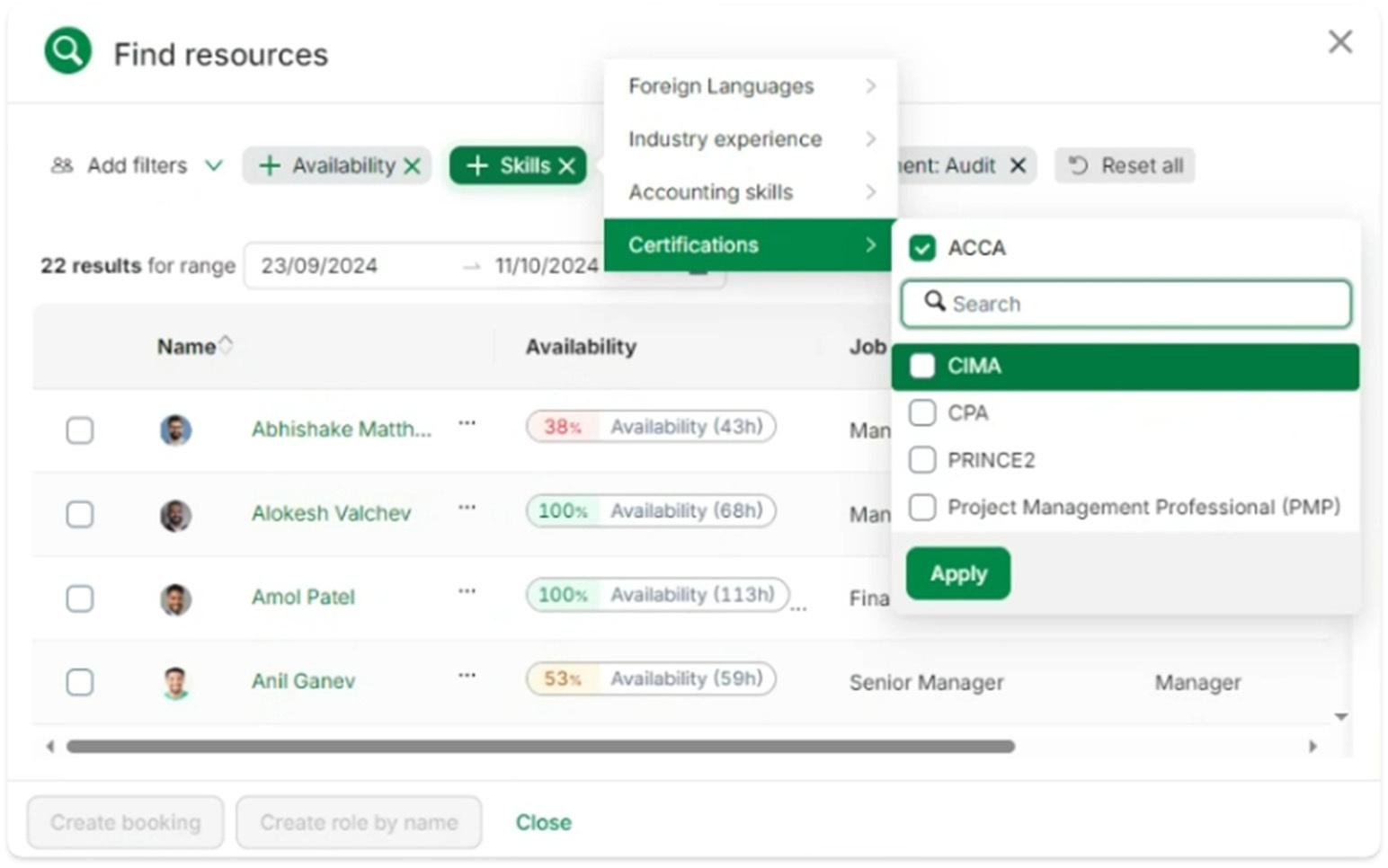
The move towards skills-based, real-time planning
This is where the conversation starts to change. Firms are rethinking how planning works altogether. Starting with the information they rely on.
#1. Planning starts with skills
Instead of scanning for who’s free, planning begins with what the work actually requires. This includes specific capabilities, level of experience, certifications, and recent work on similar projects.
This is key now because more clients are asking for it. And the cost of getting it wrong shows up quickly in delivery quality, timelines, and rework. To make that work, firms need a consistent way of defining skills across the business. This helps create a shared language that means the same thing in Audit, Tax, and Advisory.
#2. Visibility extends across the whole business
Once skills are defined properly, the next step is being able to see them. That’s why high-performing firms are moving towards a single, live view of capacity and capability across departments. Not just who is available, but what they can do, how recently they’ve done it, and where they’re currently deployed.
This changes how decisions get made. Work can be balanced more effectively. Gaps can be spotted earlier. And dependency on a small group of individuals becomes easier to manage.
#3. Planning happens earlier
Timing is another big difference. Rather than waiting for roles to be defined, leading firms are looking ahead. Forecasting demand based on pipeline, historical trends, and upcoming commitments. Identifying where capability will be needed before the pressure builds.
This type of forward view makes a huge difference. It creates time to train, hire, or rebalance work before delivery is at risk. It also reduces reliance on last-minute fixes, which tend to be more expensive and harder to control.
#4. Data has to be trusted
There’s a catch, though. Real-time planning only works if the underlying data is reliable. Kantata’s research shows that 88% of services professionals trust AI outputs enough to make operational decisions, yet 89% still spend time verifying those outputs.
For resource planning, that has real implications. If skills data is inconsistent, or if recommendations can’t be explained, decisions slow down. People revert to instinct. Workarounds appear.
That’s where auditability comes in. Being able to see why a resource was matched. What criteria were used. Whether certifications or experience were considered. Not just for internal confidence, but for client and regulatory expectations as well.
#5. The productivity gap is widening
There’s also a broader trend. Firms investing in AI-enabled planning are seeing productivity growth three times higher than those that aren’t. At the same time, demand for AI-related skills is increasing at a similar rate. And adoption is moving quickly. GenAI usage in professional services jumped from 33% in 2023 to 71% in 2024.
That creates separation. Some firms are building planning capabilities that enable them to respond faster and use their workforce more effectively. Others are still constrained by fragmented data and slower decision cycles.

How leading firms are building workforce resilience
Once planning improves, the next thing to consider is resilience.
When we talk about resilience, we’re talking about the practical, day-to-day kind that you can actually see in your delivery timelines and team stability. It’s the difference between confidently taking on a new, high-priority project and the frantic, behind-the-scenes scrambling that usually happens when resources are stretched too thin.
Skills visibility is becoming a retention tool
DHR Global’s 2026 report shows that 71% of employees cite professional development as the main driver of engagement. People want to see how they’re progressing, what they’re building towards, and where they can grow.
That’s hard to do when skills data is fragmented or outdated.
When firms have a clear, shared view of skills, it changes how work gets assigned. People can be matched to projects that stretch them in the right direction. Managers can see where experience is building over time. And conversations about development become grounded in real data. Instead of defaulting to external hiring, firms can identify capability already within the business and give people a reason to stay.
Planning the pipeline earlier
The next step is getting ahead of demand.
Reactive hiring and last-minute resourcing don’t hold up well in a constrained talent market. Leading firms are moving that activity earlier. Looking at the pipeline, identifying future requirements, and building capability before the pressure hits.
Skills-first hiring plays a role here. ManpowerGroup highlights a growing emphasis on competency over formal credentials, which opens up a wider pool of candidates and makes workforce planning more flexible.
It also connects back to internal development. When you know which skills are likely to be needed, you can build them deliberately, through training, project exposure, or targeted hiring.
Managing utilisation without burning people out
Of course, utilisation still matters. But the way firms think about it is becoming more balanced. SPI and Mosaic data point to a “Goldilocks zone” of 70–80% utilisation. Above that, short-term gains in billable hours are often offset by burnout, attrition, and declining delivery quality.
And burnout is already a factor. 83% of workers report experiencing some level of burnout, with its impact on engagement increasing. Eagle Hill’s data shows 55% of the US workforce entering 2026 in a state of burnout.
That changes how planning needs to work.
It’s not enough to keep people busy. Work needs to be distributed more evenly. Peaks and troughs need to be managed. And decisions around staffing need to factor in sustainability as well as immediate delivery needs.
This is where better visibility helps again. When you can see workloads across teams, it becomes easier to rebalance before problems escalate.
Breaking down departmental boundaries
One of the more consistent characteristics of high-performing firms is how they use their workforce. For instance, they treat Audit, Tax, and Advisory as part of a broader capability base.
That allows work to move more freely across the business. A requirement doesn’t stay confined to one team if the right expertise exists elsewhere. Resource managers have more options. And utilisation improves because capacity can be shared.
Firms with more integrated approaches to planning consistently outperform peers on revenue growth, profitability, and operational efficiency.
Put together, these behaviours start to reinforce each other.
Skills are easier to see. Planning happens earlier. Work is distributed more evenly. And the organisation becomes less reliant on last-minute fixes.
At that point, the conversation turns again, this time to the systems that support all of it.
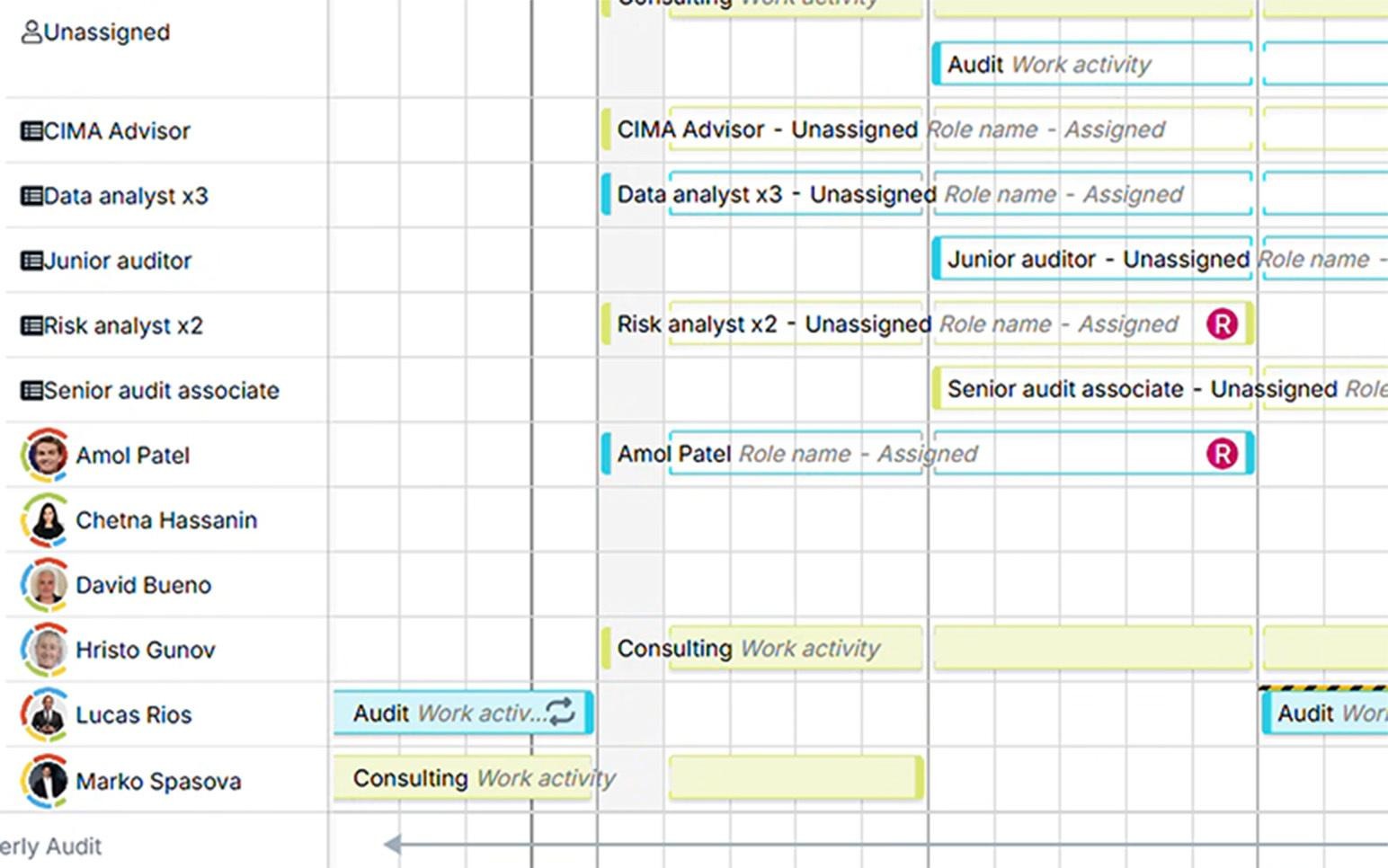
What this means for resource management technology in 2026
By this point, the requirements for resourcing technology look very different. And by the way, this isn’t about digitising spreadsheets or speeding up scheduling. The bar is higher. Firms need systems that can handle complexity, support decision-making, and stand up to scrutiny.
Skills data needs to be structured and usable
A lot of firms already have skills data. The issue is consistency. Self-reported profiles, disconnected HR systems, and inconsistent naming conventions make it hard to rely on. Two people may have the same capability, described in completely different ways.
What’s needed is a structured, standardised skills framework that works across the whole business. Something current, detailed enough to be useful, and aligned to how work is actually delivered.
Matching needs to be explainable
AI is increasingly part of the planning process. But there’s still hesitation around how far to trust it. That’s where explainability comes in.
When a system recommends a resource, planners need to understand why. Which skills matched. How experience was weighted. Whether certifications or recency of use were considered.
That level of transparency builds confidence internally. It also supports external scrutiny. Clients and regulators are paying closer attention to who is delivering work and whether they meet the required standards.
Audit trails are becoming part of everyday operations. Not an extra feature, but a baseline expectation.
Everyone needs to work from the same view
Fragmentation is still one of the biggest blockers. When leadership, resource managers, and delivery teams are all working from different data sets, alignment becomes difficult. Decisions take longer. Confidence drops.
A shared, real-time view of skills, capacity, and demand changes that dynamic. It gives everyone the same starting point, whether they’re planning next quarter’s work or responding to a last-minute requirement.
Cherry Bekaert’s data reinforces the urgency here. Every professional services firm is either modernising or planning to do so, and data integration remains the biggest challenge.
That raises a practical question: are firms choosing systems designed for professional services, or adapting general tools that weren’t built for this level of complexity?
Where Retain comes in
This is the environment Retain Cloud was built for. It brings together skills, scheduling, and performance data in one place, giving firms a consistent view across Audit, Tax, and Advisory. The Skills+ taxonomy, powered by Lightcast, provides access to more than 30,000 skills, creating a shared language across the organisation.
Matching is supported by AI, with clear reasoning behind each recommendation and full audit trails. That means planners can move quickly, while still understanding and validating decisions when needed.
In practice, that combination leads to measurable improvements. Firms using Retain are seeing:
- 35% reduction in manual processes
- Hundreds of admin hours saved
- 5–10% increase in utilisation rates
- Faster, more confident decision-making with real-time data
Resourcing technology is becoming less about administration and more about enabling better decisions, grounded in skills, supported by trusted data, and visible across the entire business.
The firms that plan better will win the work
Skills are harder to access. Delivery is more complex. Margins leave less room for error. And expectations (from clients, regulators, and internal stakeholders) are higher across the board.
That combination is what makes 2026 feel different.
Firms that can see their capabilities clearly, trust the data behind them, and act on it quickly are in a stronger position. They can staff projects earlier. Build better-balanced teams. Adjust before issues start affecting delivery.
Others will continue to rely on workarounds. Spreadsheets, last-minute reshuffling, external contractors filling urgent gaps. It keeps things moving, but it adds cost, complexity, and risk over time.
This is where planning becomes a differentiator.
The firms investing in this now are setting themselves up for the next few years. Stronger visibility. More control. And much better use of the people they already have.
In a skills-constrained market, that’s what separates firms that grow sustainably from those that are constantly catching up.
Want to see what that looks like in practice?
Explore Retain Cloud or book a personalised demo.

