




Thirty years ago, resource planning was a bit like Tetris. You had people and jobs to be done, and your job was to fit the pieces together as efficiently as possible. But, in this day and age, it's a different game entirely.
Retain has spent more than 30 years working with organisations as they grow. To understand what has changed, and what hasn't, we sat down with Tony, our Chief Architect, and Bun, our Professional Services Manager. Between them, they've spent almost 50 years helping customers tackle resource planning challenges.
One thing surprised us. The biggest challenge hasn't really changed. Growing organisations are still trying to answer the same question they've always faced: do we have the right people available to deliver the work ahead?
What's changed is the number of moving parts. Skills, certifications, utilisation, employee preferences, compliance requirements, and future demand. Every growth milestone adds another layer of complexity.
This article covers:
- Resource planning for growth: Why visibility is the first challenge
- How resource planning has changed over the last 30 years
- Resource planning data: Why job titles only tell part of the story
- Resource planning for growth: What successful organisations do differently
- The future of resource planning: Better decisions, backed by better data
Resource planning for growth: Why visibility is the first challenge
Ask most leaders what's holding back growth, and they'll often point to recruitment: Not enough people, capacity, or specialist skills.
Sometimes that's true. But according to Bun, organisations usually run into a different problem first.
"Visibility is usually the first casualty of rapid growth," he says.
It's easy to see why. As organisations expand, the number of moving parts increases quickly. New teams are created. New service lines emerge. More projects run simultaneously. Resource planning decisions become spread across departments, offices, and managers.
The spreadsheets and processes that worked years earlier start to struggle under the weight of that complexity.
Leaders become less confident in utilisation figures. Forecasts take longer to produce. Teams start competing for the same people. And questions that should be simple become surprisingly difficult to answer;
- Who has capacity next month?
- Where are the skills gaps?
- Can we take on this new piece of work?
- Do we actually need to hire?
For Tony, this challenge has remained remarkably consistent throughout his career;
"The need for a clear visible plan of work for an entire workforce or team has never gone away," he explains.
What's changed is the scale at which organisations are trying to solve the problem.
As businesses grow, resource managers often develop a deep understanding of their own teams while visibility across the wider organisation becomes harder to maintain.
Skills, experience and availability become trapped inside departments. The result is that businesses can start making decisions with only part of the picture.
That's why many organisations assume they have a capacity problem when what they actually have is a visibility problem.
Before leaders can make informed decisions about hiring, utilisation or future demand, they need confidence in what capacity already exists across the business.
Without that visibility, resource planning becomes guesswork.
How resource planning has changed over the last 30 years
Tony laughs when he describes resource planning in the early days; "Resource planning was a little like Tetris, trying to fill your plan up as much as possible."
Essentially, you needed to find available people and assign them to work.
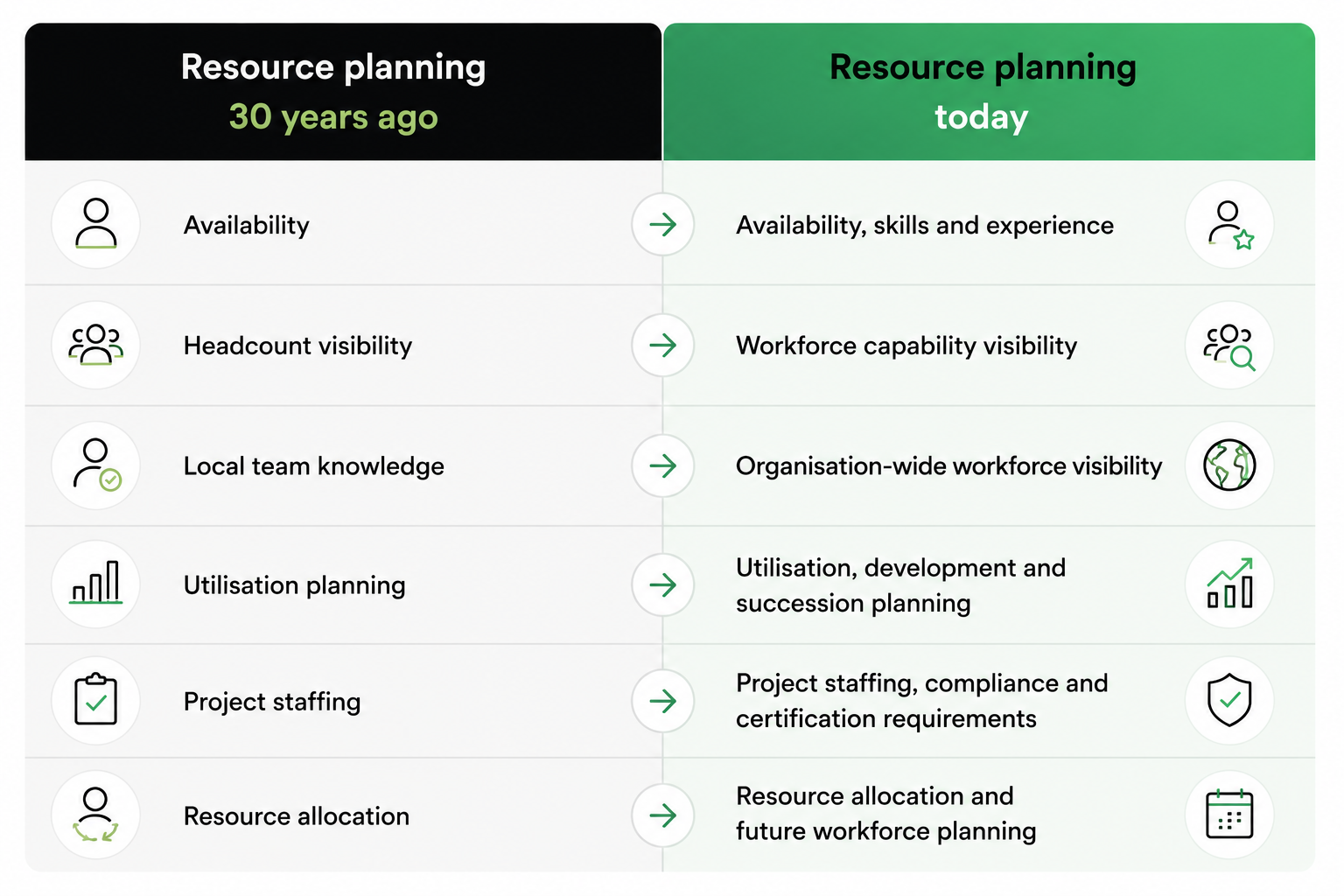
Today, the allocation itself is still important, but there are many more factors involved in deciding who should work on what.
Tony has watched these additional layers build over time;
"These days so many additional factors come into play: skills, certifications, staff satisfaction, the right team balance, as well as the obvious utilisation and budgeting considerations. What was once a two-dimensional jigsaw is now a five-dimensional jigsaw."
Bun sees the same reality when working with customers;
"Compared to five or ten years ago, organisations are taking a much more skills-centric approach to resource planning. The focus is on understanding who has the right skills, experience and potential to meet current and future demand."
Of course, this creates a challenge for resource managers. Understanding a workforce through job titles, spreadsheets and local knowledge is tricky as organisations expand into new teams, locations, and service lines.
Many businesses reach a point where the information needed to make good resource decisions exists somewhere in the organisation, but bringing it together quickly becomes the difficult part.
That's one reason resource planning has become more closely connected to skills management, workforce planning and business strategy. The decisions being made today affect project delivery next month, capability development next year and future growth plans beyond that.
Resource planning data: Why job titles only tell part of the story
Ask a resource manager about their immediate team and they’ll usually know exactly who excels at what, who’s ready for more responsibility and who gets pulled into the same type of work again and again.
Ask that same question across multiple departments, locations or service lines, and the answer becomes harder to find.
Tony has seen this happen as organisations grow;
“As organisations get larger, they traditionally have tended to end up with heavily siloed resource planning, where individual resource managers know their team and capabilities well. However, the overall knowledge at organisation level was missing.”
This missing knowledge is key because job titles never tell the full story. Two people with the same role can have very different experience, certifications, industry exposure and career ambitions. Someone may have valuable expertise from a previous project but it’s buried in a CV, spreadsheet or manager’s memory.
Bun sees this clearly when organisations start mapping skills properly;
“They often discover two things: capability gaps they didn’t know existed and expertise they didn’t know they had.”
That is where resource planning data becomes much more valuable. It gives organisations a clearer view of the capability sitting across the business, including where specialist skills are concentrated, where key-person dependency is building and where future demand may outpace available expertise.
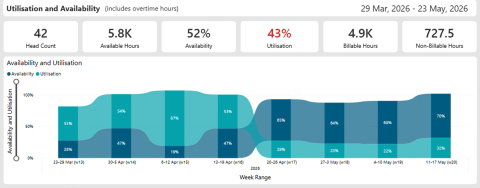
[Retain helps you to identify capability gaps across the organisation]
For growing organisations, that level of understanding supports better decisions about project staffing, recruitment, training and career development. It also helps resource managers look beyond the obvious names and build teams based on the work that needs to be delivered.
Resource planning for growth: What successful organisations do differently
Of course, not every growing organisation runs into the same problems. According to Bun, the difference often comes down to how resource planning is viewed within the organisation;
"The organisations that scale smoothly treat resource management as a strategic capability rather than an admin process."
That mindset influences everything else.
Resource planning data is maintained consistently. Processes evolve as the business grows. Leaders have visibility of demand, capacity, and skills across the organisation, rather than within individual departments. Decisions are supported by data rather than assumptions.
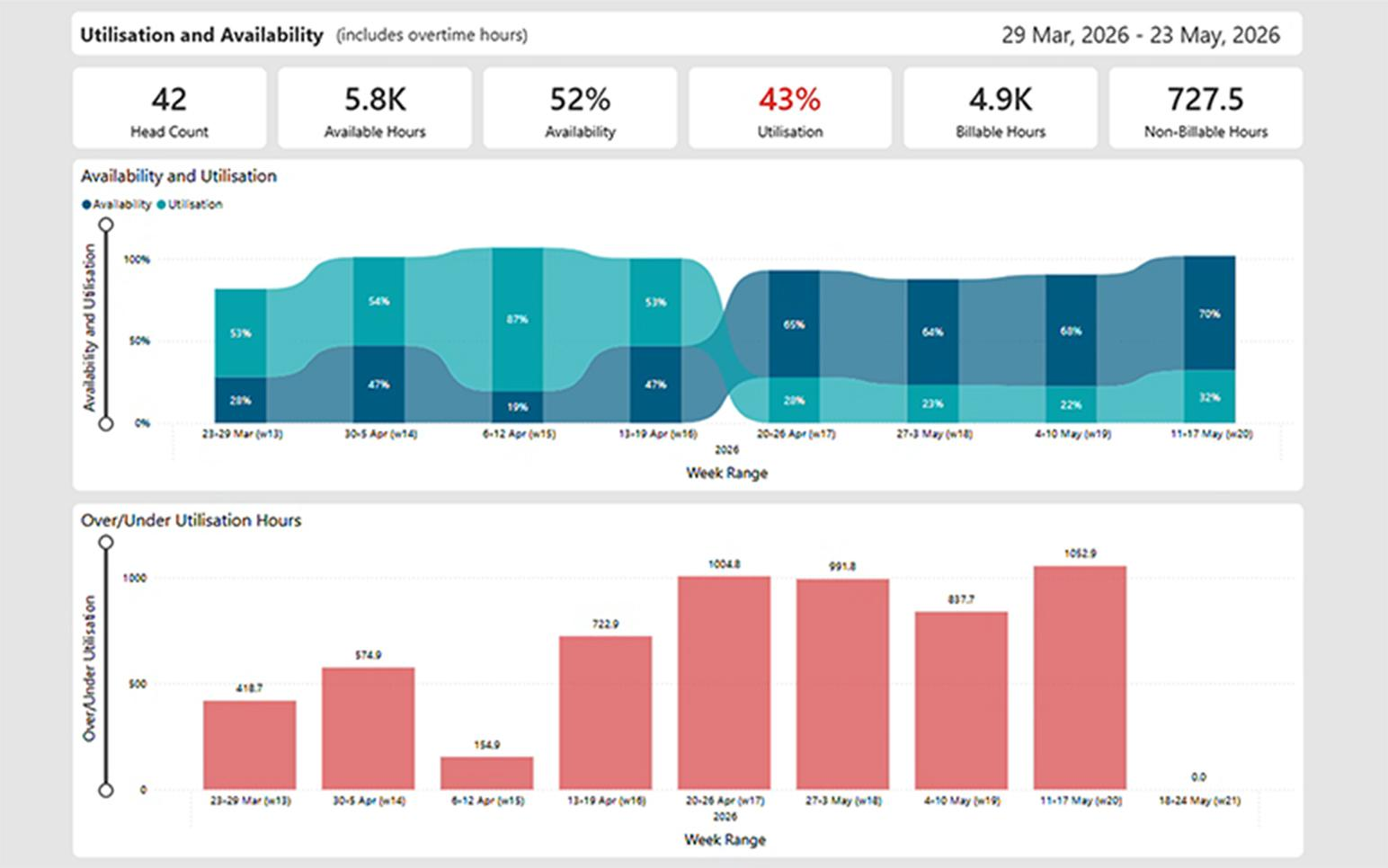
[By connecting operational planning data with reporting dashboards, teams can understand capacity, project demand, and delivery performance across departments]
Organisations that struggle with growth often face the opposite challenge. Information is found across multiple systems, planning processes vary between teams, and critical knowledge exists in spreadsheets or individual managers' heads.
The result is that resource planning becomes increasingly reactive.
Forecasts become less reliable. Bottlenecks appear with little warning. Hiring decisions are made without a complete view of workforce capability. Teams spend time solving immediate resourcing challenges instead of preparing for future demand.
Tony sees a similar pattern when organisations outgrow their existing approach to planning; "A common warning sign is finding they need an answer to a utilisation question, and not having the tools at their disposal to readily answer those questions."
At that point, the challenge is no longer assigning people to work. The challenge is having enough confidence in the underlying data to make informed decisions.
The organisations that handle growth most effectively build that confidence early. They invest in visibility, maintain accurate resource planning data and create a shared understanding of capacity and capability across the business.
The future of resource planning: Better decisions, backed by better data
For all the changes resource planning has gone through over the past 30 years, Tony believes one thing will remain constant: people will still be responsible for making the final decision.
What will change is the amount of information available to support those decisions.
As organisations continue to grow, resource managers will be expected to process increasing amounts of data. Skills, certifications, utilisation, future demand, project requirements and workforce preferences all need to be considered when building effective teams.
That's where automation and AI can help.
"Resource planning platforms will have to provide tools and interfaces which allow AI to empower resource managers to make well-optimised revenue-generating allocation decisions," says Tony.
Importantly, he doesn't see AI replacing human judgement.
"Everything needs to remain explainable, comparable, overridable, and never take ultimate control out of the resource manager's hand."
That balance is likely to become increasingly important as organisations look for ways to manage complexity without adding more administrative overhead.
The objective remains familiar: putting the right people onto the right work at the right time.
The difference is that resource managers now have access to far more information than previous generations ever could. Used well, that information helps organisations respond faster to change, identify capability gaps earlier and make better decisions about future growth.
Ready to gain a clearer view of your workforce?
The challenges Tony and Bun describe aren't unique. They're the same issues growing organisations have been grappling with for decades: limited visibility, disconnected planning processes, hidden skills, and increasing complexity.
The difference today is that organisations have access to far better tools and data than ever before.
Retain Cloud helps firms bring resource planning, skills intelligence and workforce visibility together in one platform. With a shared view of capacity, demand and capability, resource managers can make better decisions, build stronger teams and plan for growth with confidence.
Book a personalised demo to see how Retain Cloud can help your organisation turn resource planning data into better business decisions.

