




January has a habit of reminding us how quickly conditions can change. Living in the South West, sudden weather changes are part of everyday life. You learn to pay attention to early signs, prepare where you can, and accept that not everything will unfold exactly as forecast.
Resource management works in a similar way, though the stakes are often higher and the consequences longer lasting. Demand fluctuates, priorities move, and plans that felt solid a few weeks ago can quickly come under pressure. The challenge for organisations is balancing what they can predict with what they need to stay flexible around.
Effective resource management depends on visibility and timing. For instance, spotting demand early, understanding capacity across teams, and making informed decisions before pressure builds. Without it, the impact is felt quickly by delivery teams, clients, and ultimately the business.
What this blog covers:
- Why demand forecasting in resource management is inherently uncertain
- How fluctuating demand impacts workforce wellbeing, utilisation, and delivery
- The role of early visibility in reducing last-minute resourcing pressure
- How proactive planning helps organisations respond to change with confidence
- Where technology can support better forecasting, decision-making, and communication
The reality of unpredictable demand

Forecasting demand is a core part of resource management, but it's rarely straightforward. Sales pipelines slip, project timelines move, and priorities change… with little warning. In fact, 73% of chief procurement officers identify demand volatility as one of the top challenges over the next five years. Even when forecasts are built on solid data, the outcome doesn't always match what was expected.
For instance, one week, teams are preparing for a surge of work that doesn’t fully materialise. The next new demand appears suddenly, pulling people away from existing commitments. This variability puts pressure on planning processes and tests how quickly organisations can respond without disrupting delivery.
You need to see demand early enough to act, understand how it affects capacity across teams, and make adjustments before pressure builds. When that visibility is missing, decisions become reactive, often relying on last-minute changes that create friction for both managers and delivery teams.
💡 Tip: Use forward-looking resource forecasts to spot demand pressure early. Retain helps teams model upcoming work against real capacity, so potential clashes, skill shortages, or utilisation spikes are visible before they become last-minute problems.
The impact on teams and delivery

Interestingly, billable utilisation has fallen from 73.2% in 2021 to just 68.9% in 2024, below the 75% threshold that professional services firms need to maintain healthy margins. At the same time, on-time project delivery has dropped to 73.4%, down from over 80% just three years ago.
The problem is, resource managers are often forced to rebalance workloads at short notice, asking some teams to absorb additional pressure while others experience sudden drops in utilisation. Neither scenario is sustainable for long.
Intense demand can lead to extended hours, increased stress, and a loss of focus on development or quality. In fact, 52% of employees reported feeling burned out in 2024, with Grant Thornton's research showing a 15 percentage-point increase from the previous year. Quieter periods bring a different challenge: underutilisation, uncertainty, and difficult questions about future work. In both cases, teams feel the consequences of planning decisions, even when those decisions are made with the best available information.
Maintaining balance depends on understanding how work is distributed, where pressure is building, and which skills are in short supply. Without this insight, you risk over-relying on a small group of individuals, creating bottlenecks that increase burnout and reduce resilience.
This happens a lot across professional services, with mid-level employees reporting the highest burnout rates at 54%. (And these are the very people organisations rely on to bridge senior direction with frontline delivery.) Similarly, research from Boston Consulting Group found that 48% of workers across eight countries are struggling with burnout. But when employees feel genuinely included at work, burnout rates are cut in half.
💡 Tip: Protect team wellbeing by monitoring workload balance in real time. Retain gives resource managers visibility into who’s overextended, who has capacity, and where skills are being overused, making it easier to rebalance work before burnout sets in.
Planning ahead with early visibility

The difference between controlled change and constant disruption often comes down to how early organisations can see what’s coming.
Resource planning tools allows leaders to understand what work is confirmed, what is likely, what is tentative, and how different scenarios affect capacity across the business.
Early visibility also leads to better conversations. When you can see pressure building weeks or months ahead, you have time to explore options, such as adjusting timelines, redistributing work, investing in upskilling, or securing additional support. Decisions feel calmer, more considered, and easier to explain to both teams and stakeholders.
Over time, this approach builds organisational resilience, teams spend less time firefighting, and the business is better equipped to absorb change without compromising delivery or wellbeing.
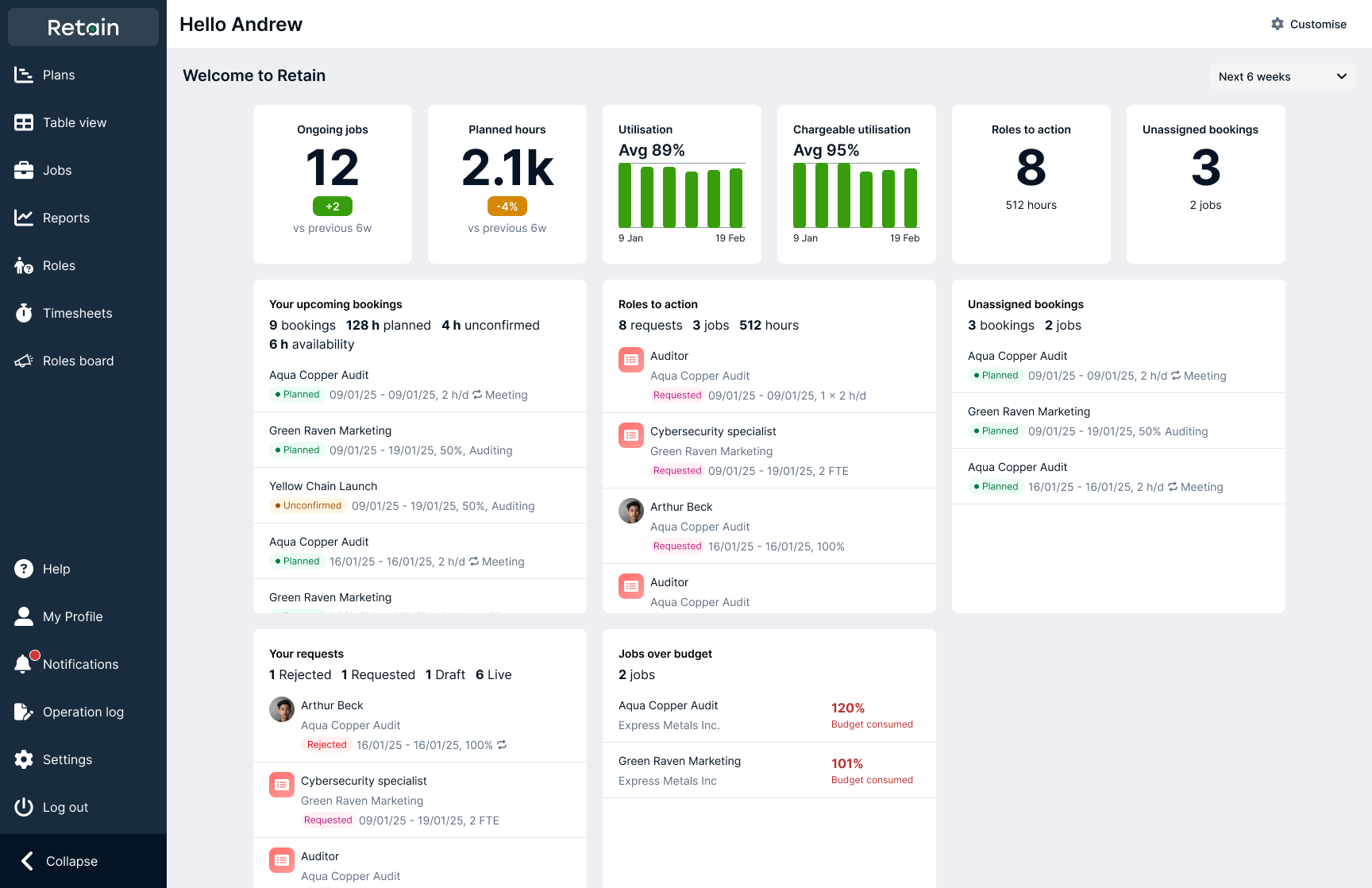
💡 Tip: Bring confirmed and potential demand into a single planning view. Retain helps teams visualise upcoming work alongside current capacity, making it easier to test scenarios, plan contingencies, and act before pressure turns into disruption.
Reducing risk through better preparation
Uncertainty in demand also introduces risk. When organisations are forced to make decisions with incomplete information, the margin for error narrows. Teams are stretched, commitments are made with less confidence, and small misjudgements can have outsized consequences.
This is where the right preparation comes in. Having a clearer view of skills, availability, and future demand allows leaders to act earlier and with more options. The financial impact is huge. Revenue per consultant dropped to $199K in 2024 as declining utilisation squeezes margins. Instead of reacting to pressure once it arrives, organisations can plan adjustments gradually, reducing disruption to teams and delivery.
Likewise, better preparation also supports more confident decision-making. Leaders can weigh trade-offs with a fuller understanding of impact, assess where flexibility exists, and communicate changes with clarity.
Over time, you’ll see fewer last-minute reallocations, fewer rushed conversations, and fewer compromises on quality or wellbeing.
💡 Tip: Reduce planning risk by making skills and capacity visible together. Retain connects who is available with what they can do, helping organisations make informed trade-offs and avoid over-reliance on a small group of individuals.
Technology as an enabler, not a replacement for judgment
It’s safe to say resource management will always rely on experience, context, and human judgment. What technology (like Retain) can do is remove friction from the decision-making process by making information clearer, more timely, and easier to act on.
When planning tools surface reliable data on demand, capacity, and skills, managers spend less time chasing information and more time making decisions that matter.
The most effective platforms support this without adding complexity. They fit into existing workflows, connect planning with delivery realities, and provide insight that can be shared across teams. Used well, technology strengthens confidence in decisions rather than dictating them.
For organisations managing fluctuating demand and diverse skill sets, this kind of support becomes essential.
💡 Tip: Choose tools that support scenario planning and shared visibility. Retain enables resource managers, project leads, and leadership teams to work from the same data, improving alignment and reducing friction when plans change.
Build confidence through better visibility
If one thing’s for sure, it’s that uncertainty is a constant in resource management. But what separates resilient organisations from reactive ones is how early they see those changes and how prepared they are to respond.
Clear visibility into demand, capacity, and skills gives leaders more room to manoeuvre. It supports better decisions, protects teams from unnecessary pressure, and helps maintain delivery standards when conditions change. Over time, this approach builds confidence across the business, from resource managers and delivery teams through to clients and leadership.
Tools like Retain support that preparedness by bringing insight and structure to complex planning decisions. By combining forward-looking visibility with real-time understanding of workload and skills, organisations are better equipped to adapt without disruption.
With the right information and the right support in place, resource management becomes less about firefighting and more about control, even when uncertainty is part of the picture.
Want more control over resource planning?
Retain helps organisations anticipate change, balance workloads, and make confident resourcing decisions with real-time visibility into demand, capacity, and skills.
👉 Book a demo to see how Retain supports proactive resource management.
