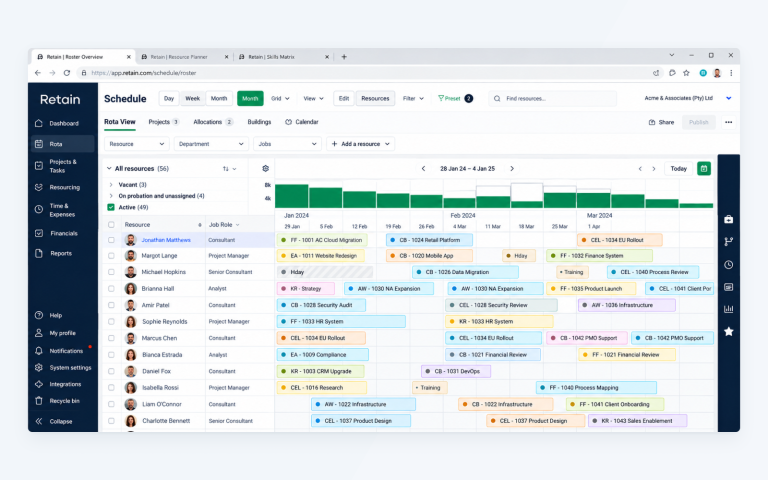
It happens all the time: a project gets signed, everyone’s ready… and then nothing happens. The problem often comes down to the disconnect between resource management and project management.
In fact, only 49% of projects are completed on time, and around 70% fail to meet their objectives entirely.
What’s causing this?
→ Resource management is looking ahead, forecasting demand, surfacing constraints, and spotting skill gaps early.
→ Project management is trying to build a detailed plan without knowing who’s actually available or what’s realistic.
When those two streams don’t talk, kickoff slows, teams scramble, and predictability tanks.
So we asked Linked Workforce’s Andre Franklin, who’s implemented both systems across professional services firms, to break down what actually needs to happen. His take? When resource management sets the outline, project management can build the plan faster, with fewer surprises and far less drama.
Here’s how he explains it.
What resource management does that project management can’t

People group resource management and project management together as if they’re interchangeable or tackling the same job. But they’re not.
Project management shines once the work is defined, tackling tasks, milestones, and dependencies. But before any of those details exist is where resource management does the heavy lifting.
Resource management tells you:
- What kind of work is coming
- Which skills you’ll need
- Who might be available
- Where the real constraints are hiding
Andre explained it perfectly: “In short, resource management excels at enterprise-level forecasting. It helps an organisation understand what work it plans to take on, what capabilities it will need, and roughly how much time or cost will be involved, long before detailed engagement plans exist.”
And then he dropped the analogy every RM leader is going to steal forever:
“I often describe it as the difference between writing the table of contents and writing the book.”
That’s exactly it. Resource management sets the direction. Project management builds the detail. And when PM teams finally start writing those “chapters”? They’re building on top of something grounded.
Where the real disconnect happens between resource management and project management

Let’s talk about the messy middle, where projects slow down, handoffs get fuzzy, and two teams with the same goal accidentally work in silos.
Because here’s the uncomfortable truth: the biggest gap between resource management and project management is usually operational. It’s the handoff. The moment when early forecasting should slide seamlessly into project planning… but usually doesn’t.
Andre sees this all the time. “The biggest gap usually appears at the point of integration, not simply technical integration, but the functional handoff too.”
Resource managers create thoughtful forecasts. They map out early timelines, flag skill constraints, and workload clashes weeks before a project manager ever opens a planning tool. But far too often, all that work stalls upstream instead of becoming the foundation engagement managers build from.
Andre put it bluntly: “Too often, resource management teams produce thoughtful early forecasts and capacity outlines, but those insights never make it downstream into the tools or processes engagement managers rely on.”
And the result?
- Project managers start from scratch.
- Resource managers feel unheard.
- Kickoff dates drift.
- And the business pays for the disconnect.
Andre uses the same table-of-contents analogy here, because the problem is literally that stark: “It’s the equivalent of creating a thoughtful table of contents and then ignoring it when writing the chapters.”
Ouch. But accurate. In fact, research shows that 61% of project delays could be prevented with comprehensive upfront risk identification. When resource forecasting stays disconnected from project planning, firms are essentially choosing to ignore the warning signs that prevent over half of potential delays.
The opportunity (and this is the part firms consistently underestimate) is to turn early resourcing insight into the first draft of the project plan.
“Resource management’s early outline needs to evolve into the engagement manager’s initial draft plan. When that connection doesn’t exist, both sides lose visibility, and the firm loses time.”
If you’ve ever wondered why your engagements start late even when the work is technically ready… this is it.
How early forecasting changes what project managers can actually achieve

Here’s a spicy truth: most project plans look perfect until reality shows up. And reality always shows up. This is why project planning software is so important
That’s why early resource forecasting is way more important than people give it credit for. It gives project managers something they rarely get at the start of an engagement:
A realistic picture of what they’re walking into, before they open a scheduling tool, map dependencies, or start negotiating timelines.
Resource managers already have eyes on constraints that don’t appear in a tidy Gantt chart — the kind of “invisible truths” that derail delivery later.
Andre describes it as giving engagement managers a crucial head start: “Early resource forecasting can be a sneak preview into the expectations and constraints engagement managers will need to navigate.”
This is about surfacing the stuff that actually affects the plan:
- A senior specialist going on parental leave
- A client sponsor who’s impossible to schedule
- A recurring engagement with problems that quietly carried over
- Skills the firm needs but doesn’t yet have in place
These aren’t risks you want to “discover” halfway through delivery.
As Andre puts it: “Resource management picks up on organisational limits tied to timing, skills availability, or competing workloads that won’t appear in a clean project plan but matter enormously in day-to-day operations.”
It’s not that engagement managers don’t know their clients. They absolutely do. But resource managers see patterns earlier.
Together, they build better, calmer, more grounded plans.
Andre sums it up perfectly: “When the partnership works well, engagement managers start planning from a place of confidence rather than urgency.”
That’s the magic.
Less scrambling.
Fewer midstream rethinks.
More predictable delivery.
A real example of resource management saving a project before it even started

Let’s walk through a scenario that happens way more often than firms admit: A project looks simple on paper, but underneath, something structural is missing, and no one catches it until delivery starts falling apart.
In this case, it was an architecture engagement. Straightforward request. Skilled role. Clear scope. Nothing unusual… until resource management took a closer look.
Andre explains what happened: “The request itself wasn’t unusual, but as the resource management team reviewed it, a key issue surfaced: the organisation didn’t yet have a standard approach for this type of work, nor a centre of excellence the architect could rely on if they ran into challenges.”
Translation? Hiring a great architect wasn’t the problem. Dropping them into a brand new capability with zero internal scaffolding was the problem.
Here’s where the magic of early intervention comes in.
Instead of rubber-stamping the request, the resource manager flagged the risk to leadership before anyone built a project plan or hired someone into a shaky environment.
Andre describes the decision that followed: “Hiring a new architect would have given the organisation a qualified person, but it wouldn’t have given that person the technologies, templates, SOPs, or delivery guidance needed to perform the work in a way that aligned with their new employer or the client.”
So, what did they do?
They brought in a specialised third-party partner for the first engagement, someone who already had the frameworks, accelerators, and templates ready to go. At the same time, they staggered hiring a full-time architect who could onboard into something more solid, not a capability-shaped void.
This did three important things:
#1. Delivered a smoother, more predictable client experience
#2. Avoided burning out a brand-new hire
#3. Gave the firm space to validate whether a full center of excellence made sense
Andre calls it out clearly: “Without resource management surfacing the issue early, the gap would likely have emerged much later — during delivery, when it becomes far more costly and disruptive to correct.”
That’s the whole point. Early forecasting and capacity planning is key to catching the hidden risks that tank projects later. And fixing them when they’re still cheap and painless to fix.
Why leadership should care about aligning resource management and project management

If there’s one takeaway for leaders, it’s this: your delivery model can only mature if resource management and project management mature together. One without the other doesn’t scale well.
As Andre puts it: “Without strong alignment between resource management and engagement management, an organisation’s ability to mature its delivery model will eventually stall, or worse, decline.”
The cost of standing still is real. McKinsey research shows companies that actively reallocate resources can be worth 40% more after 15 years than those that don’t. Meanwhile, only about half of executives say their companies effectively align their budgets with their corporate strategies. The disconnect between resource management and project management is a root cause of this misalignment.
When only one function levels up, you get the symptoms every professional services leader knows too well:
- Misaligned expectations
- Delayed project starts
- Rework disguised as ‘refinement’
- Teams operating with partial information
- Quiet frustration that eventually becomes attrition
Sound familiar?
Andre explains the real risk:
“When only one side matures — resource management without engagement management, or engagement management without resource management — the imbalance creates instability. It can incubate mistrust, force teams to operate with partial information, and delay project starts or increase the likelihood of project misfires.”
But here’s the optimistic part, because yes, we’re ending on a hopeful note:
When the outlines (RM) and the chapters (PM) stay connected, everything sharpens. Visibility improves. Delivery becomes steadier. Teams waste less time on coordination and more time doing impactful work. Leaders finally see a clean line from pipeline → staffing → delivery → outcomes.
Andre said it best:
“When done well, alignment reduces noise, increases trust, and gives leaders a clearer line of sight from pursuit to delivery.”
That’s the promise. Not perfection, but predictability.
Ready to eliminate the gap between forecasting and delivery? See how Retain connects resource management and project management in one place.
Our editorial process
Written from interviews with resource managers in IT consulting firms, alongside anonymised patterns from Retain customer data. Direct quotes are used with permission and lightly edited for length.
Reviewed for accuracy by Retain’s resource management practice leads before publication. Claims about outcomes are checked against source data or removed.
The summary at the top of this page is generated from the article text. The article itself is written and edited by people. AI is not used to draft claims, quotes or data.
Spotted something wrong? Email editorial@retaininternational.com and we will correct it, noting the change at the foot of the article.