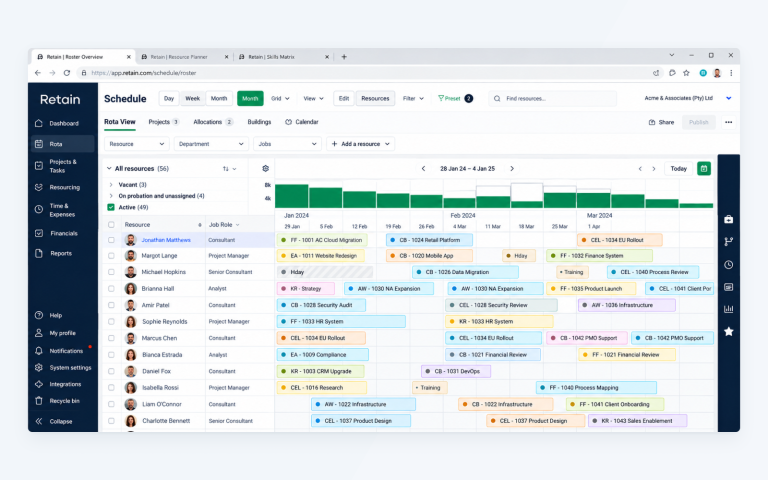
Resource management and risk—are two terms that may not always appear together, but should. Why? Because managing risks is an essential yet often overlooked part of resource management. This article explores how to seamlessly integrate the two using resource forecasting.
From identifying common risks, to exploring real-life case studies, and offering actionable tips, we’ll walk you through how to improve your resource management strategy. The end goal? To move from being risk-aware to risk-prepared.
But first, what is risk in resource management? Let’s take a closer look.?
Examples of risks in resource management
In resource management, identifying and mitigating risks is not just an add-on; it’s central to the efficient allocation of resources, be it talent or budget. So, let’s zoom in on specific risks you can’t afford to ignore:
- Over-staffing – Additional employees means extra salaries, benefits, and operational costs which quickly add up.
- Underutilised talent – If you’ve got expertise sitting right there but poor planning, this talent goes to waste.
- Skills mismatch – Conversely, assigning work to employees who lack the necessary skills can negatively impact outputs and lead to project delays.
- Understaffing – You may need to lean on external contract specialists which can come with higher price tags, particularly for last-minute work.
- Overallocation – Spreading resources too thinly across multiple projects can lead to burnout and decreased productivity.
- Poor forecasting – Inaccurate predictions of resource needs can result in either wasteful excess or crippling shortages.
- Lack of adaptability – The inability to quickly redeploy resources in response to changes can make your business less agile and vulnerable to risks.
- ?Budget mismanagement – Misallocation of financial resources like client budgets can lead to going over or under budget.
- ?Outdated tools – Using manual or incompatible software can result in inaccuracies and inefficiencies.
Fundamentally, don’t leave risk management until a crisis hits. Instead, find a way to mitigate risks, proactively. All of which lays the groundwork for a more efficient and resilient business.
And this is where resource forecasting comes in. ?
Why resource forecasting is crucial for risk management
Put simply, accurate resource forecasting acts as an early warning system for your business. But only if you have the data to back you up.
For example, for effective forecasting, you need access to budget constraints, current expenditures, and expected revenues – just to name a few.
So, when it comes to your quarterly projections or staffing needs for upcoming projects – with the right data at your fingertips ? – you can identify and navigate potential issues like bottlenecks, staffing problems, and financial constraints… Long before they become a crisis.
But resource forecasting doesn’t just flag potential issues. Businesses use it to meticulously plan and allocate the right resources for each project. Or, even hire additional specialists, ahead of time to tackle more complex projects or greater demand.
The result? Businesses go beyond educated guesses and firefighting. They make strategic decisions based on reliable resourcing data to mitigate risk and seize opportunities.
The bottom line: Resource forecasting prevents risk proactively while making sure every pound and every minute is planned and accounted for.
To put this into perspective, let’s look at a real-life example…
Case study: How James Cowper Kreston reduced resourcing risk
James Cowper Kreston is an accounting, audit and tax firm. As it grew, its workload, headcount and number of concurrent jobs reached the point where spreadsheet-based resource planning could no longer keep up.
Challenge ❌️
Resource planning was managed in Excel, which gave the firm only a three-to-six-month view of upcoming work. Without longer-term visibility of future demand, staffing and budgets, planning ahead and taking on new work carried more risk than it should.
Solution ✅️
The firm moved resource planning onto Retain, first on-premise and later on Retain Cloud. That centralised planning in one platform, with clear visibility of future demand, staffing requirements and utilisation.
Plus, reporting gives managers ongoing reassurance that allocations are right for every project. The move to the cloud also reduced dependency on internal IT and cut routine system downtime.
Tangible benefits ?
Longer forecasting horizon: Planning visibility extended from 3–6 months to a full 12 months, giving early sight of prospective downtime and upcoming capacity.
Smarter hiring: With committed work and future requirements in view, the firm can see whether existing teams have capacity or whether external talent is needed. That removes reactive, knee-jerk hiring.
Lower delivery risk: Utilisation is up by more than 5%. The firm can also take on new engagements confident they can be delivered, which protects its reputation.
Read the full case study here.
The visibility James Cowper Kreston gained over future work and staffing echoes the practical tips we’re about to delve into. Their approach underlines the real-world efficacy of forward planning and proactive risk management. Let’s take a look…
Also update the “On this page” entry to match the new H2.
Practical tips for implementing resource forecasting
Ready to make risk management a reality in your business? This section will arm you with practical tips to transition from risk-aware to risk-prepared all through the power of resource forecasting.
Set resource forecasting KPIs
To prevent encroaching into risky territory, it’s best practice to have relevant KPIs and margins that flag when you may be near. Like acceptable levels of under-use, before it tips profits. Having KPIs isn’t just about metrics; it’s about creating safety nets. KPIs act as early indicators, letting you intervene before small issues escalate.
Balance quantitative and qualitative
Data analytics on historic data and trends, combined with real-time data and client and industry insights gained from team members creates broader visibility. Mixing data types isn’t just comprehensive; it’s pragmatic. While numbers provide objectivity, qualitative insights bring the subtleties that data might miss.
Use data insight the right way
Proactive risk management requires both strategic vision and operational follow-through. Ask your leaders to review the findings to gain their expert view and use this in resource planning. Proper utilisation of data is more than just gathering it. A strategic review by leaders can offer a unique blend of experience and data-driven foresight.
Involve multiple departments
Operations, finance, HR – for example – will have different risk considerations which you can factor in. By pooling risk perspectives from various departments, you create a more holistic risk profile.
Use the right tools
There are specialist tools dedicated to resource planning and risk-focused forecasting. Leveraging tech with built-in AI can process high volumes of data and spot trends human analysis might miss. AI-powered tools can crunch data faster and more accurately than a human, giving you an edge in risk management.
Think agile
Design fluid forecasts so that you can tweak resource plans as new data feeds in. Whilst it’s great to plan ahead, long-term plans often create rigidity. Fixed plans can become obsolete. An agile approach allows for real-time adjustments, providing a safety net against unforeseen risks.
Review past performance
Regularly look back at forecasts versus reality so you can see how accurate they were – and use this insight to tweak current forecasts. History is a treasure trove of insights. Regularly reviewing past forecasts versus actuals helps you fine-tune your future plans, making them more reliable.
To sum up, implementing resource forecasting can be a transformative step in solidifying your risk management strategy. From setting relevant KPIs to adopting an agile approach, each step helps you to make informed, proactive decisions. Whether it’s leveraging cutting-edge tools or incorporating insights from multiple departments, these practical tips offer a comprehensive guide to avoiding risks and optimising resources effectively.
Final thoughts: Mitigating risk with financial forecasting
As we’ve seen, resource forecasting gives businesses the ability to navigate uncertainty. With a data-driven approach, leveraging both historical and real-time data, businesses are empowered with smart risk management, both operationally and financially.
?No longer are bottlenecks and under-usage a major damper on profit margins.
… And resourcing emergencies doesn’t create chaos. That’s because resource forecasting supports a proactive, rather than reactive, approach to resource planning. It provides the visibility to allow you to adapt with contingency plans.
Ready to gain greater control of resource risk management? See how our resource management software can help. Book a demo here now.
Looking for more resource forecasting insights?
Our editorial process
Written from interviews with resource managers in IT consulting firms, alongside anonymised patterns from Retain customer data. Direct quotes are used with permission and lightly edited for length.
Reviewed for accuracy by Retain’s resource management practice leads before publication. Claims about outcomes are checked against source data or removed.
The summary at the top of this page is generated from the article text. The article itself is written and edited by people. AI is not used to draft claims, quotes or data.
Spotted something wrong? Email editorial@retaininternational.com and we will correct it, noting the change at the foot of the article.