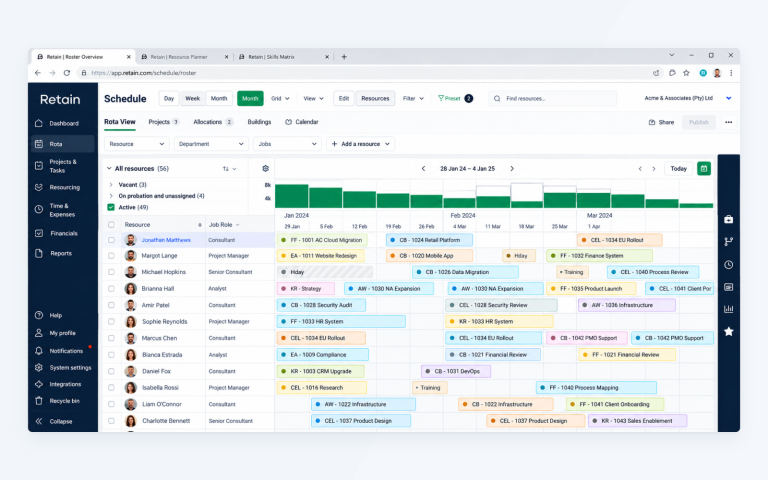
Good resource optimisation means considering the alternatives and working out which option gives you the strongest result. There’s a lot to weigh up, from skills and availability to grade, cost, utilisation and existing commitments.
So, how many possible resource plans can your team realistically compare? 5? 10? 20?
With AI, that number can reach into the hundreds. And that opens up a very different approach to resource planning.
Key takeaways:
|
Why resource planning creates so many scenarios
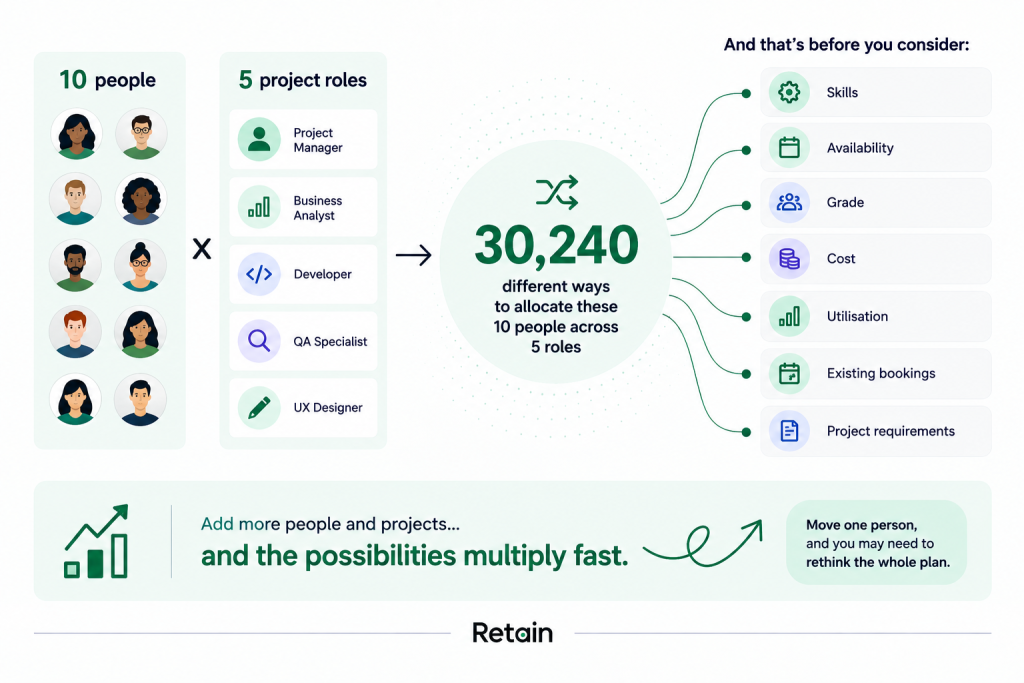
It doesn’t take a huge resource plan for the numbers to get pretty big. Let’s say you have five project roles to fill and ten people who could do the work. Sounds manageable? But there are already 30,240 different ways to allocate those ten people across the five roles.
Then you have all the usual things to think about: skills, availability, grade, cost, utilisation, existing bookings, and project requirements.
Add more people and projects into the mix, and the possibilities multiply fast. Move one person to a different project, for example, and you may need to rethink the work they were originally booked for too.
You can see the problem here.
For a large professional services firm, nobody has time to work through every possible combination manually. Resource managers have to narrow down the options and use their experience to decide which ones are worth exploring.
What is resource scenario planning?
Resource scenario planning lets you test different ways of allocating people before making any changes to your live resource plan.
Let’s say a consulting firm has just won a major new project. The resource team could create one scenario focused on finding the best skills match, another on improving utilisation, and another on keeping delivery costs down.
You can then compare the options and see what each one means for the wider resource plan before deciding which route to take.
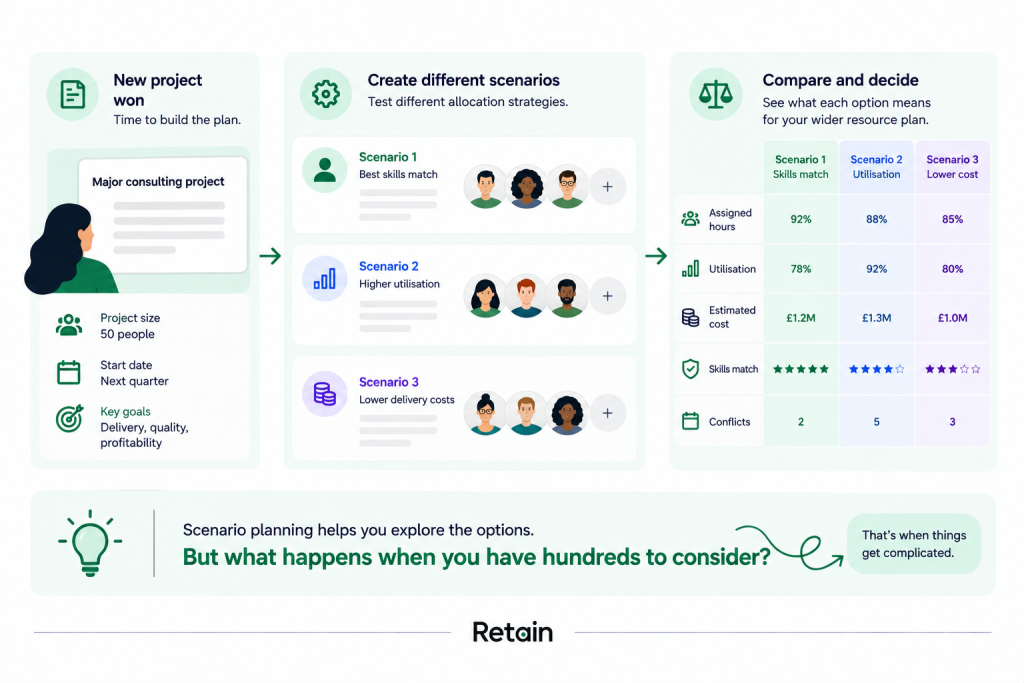
Pretty useful, right? The trouble starts when you have hundreds of possible options to explore and several priorities competing for your attention at once.
Where manual scenario planning reaches its limits
Resource managers are already pretty good at narrowing down the options. Experience tells you who could be a good fit, which projects need attention, and which constraints you need to work around.
The tricky part is just how many things you’re trying to balance with every decision.
| Factor | What the resource manager needs to consider |
| Skills and experience | Does the person have the right skills and level of experience for the work? |
| Availability | Are they available for the full period required? |
| Grade | Does their seniority fit the role and planned team structure? |
| Utilisation | How will the allocation affect individual and team utilisation? |
| Cost | What will this allocation mean for delivery costs? |
| Existing bookings | Will moving someone create a problem elsewhere in the plan? |
| Project requirements | Are there specific client, location or timing requirements to consider? |
Now imagine trying to balance all of that across hundreds or thousands of people and multiple projects.
There’s only so much a resource manager can realistically compare. You might work through five, ten, or even twenty scenarios in detail, but what about the hundreds of other possibilities?
Some of those could give you a stronger resource plan. You simply wouldn’t know they were there.
Resource scenario planning vs resource optimisation
Scenario planning works well when you already have a few ideas you want to test. You can create different versions of the plan, move people around, and see how each option plays out.
Resource optimisation takes things a step further.
Technology can work through far more possible allocations, using the objectives and constraints you’ve set to find options you may never have thought to test yourself.
So, what does that difference look like? Here’s a quick comparison:
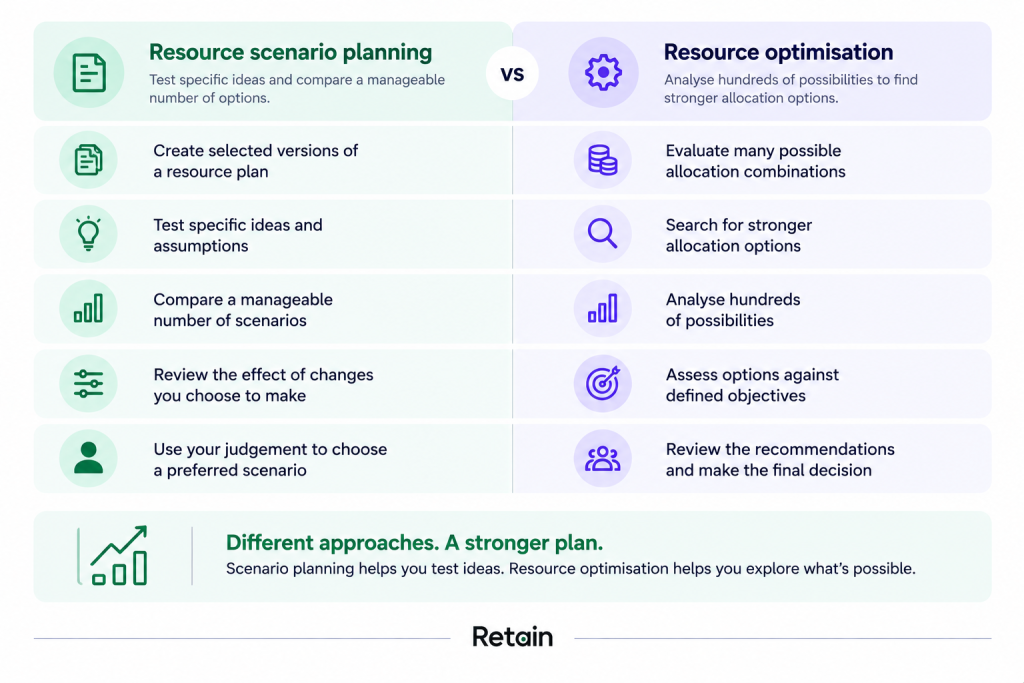
Both can play a useful role in resource planning. Optimisation simply gives your team the ability to consider far more possibilities than they could work through themselves.
What should you optimise a resource plan for?
Here’s another challenge: what does a strong resource plan actually look like?
The answer depends on what your business is trying to achieve. You might want to:
- Improve resource fit: Find people with the right skills and experience for the work.
- Increase utilisation: Make better use of the capacity you already have.
- Control delivery costs: Understand how different allocation choices affect cost.
- Get the right grade mix: Make sure work is allocated at the right level of seniority.
- Reduce scheduling conflicts: Avoid clashes and overbookings across the plan.
Of course, you’ll probably care about more than one of these at once. And that’s where things get interesting.
Your strongest skills match might be a more expensive option. Moving someone to improve utilisation could leave another project short. Fix one scheduling conflict and you might create another somewhere else.
This is where having more scenarios to compare can really help. You get to see how different choices play out across the wider resource plan before deciding which one works best for your business.
How AI changes resource planning at scale
Now, what happens when AI joins the resource planning process?
Suddenly, you can explore hundreds of possible allocations without asking your resource managers to build and compare every scenario themselves. AI can work through the options using the priorities and constraints you set, from skills and availability to cost, utilisation, and scheduling conflicts.
That leaves your resource managers with more time to do what they’re good at. They can review the options, add their knowledge of the business, and decide which resource plan makes the most sense.
And their experience is still a huge and super important part of the process. They might know that someone has a great relationship with a particular client, that two people work especially well together, or that a project would give someone the experience they need for their next career move.
AI can work through hundreds of possibilities. Your resource managers bring the context, experience and judgement to choose what happens next.
What happens when you compare hundreds of resource planning scenarios?
Comparing hundreds of options sounds impressive. But does it actually lead to a stronger resource plan?
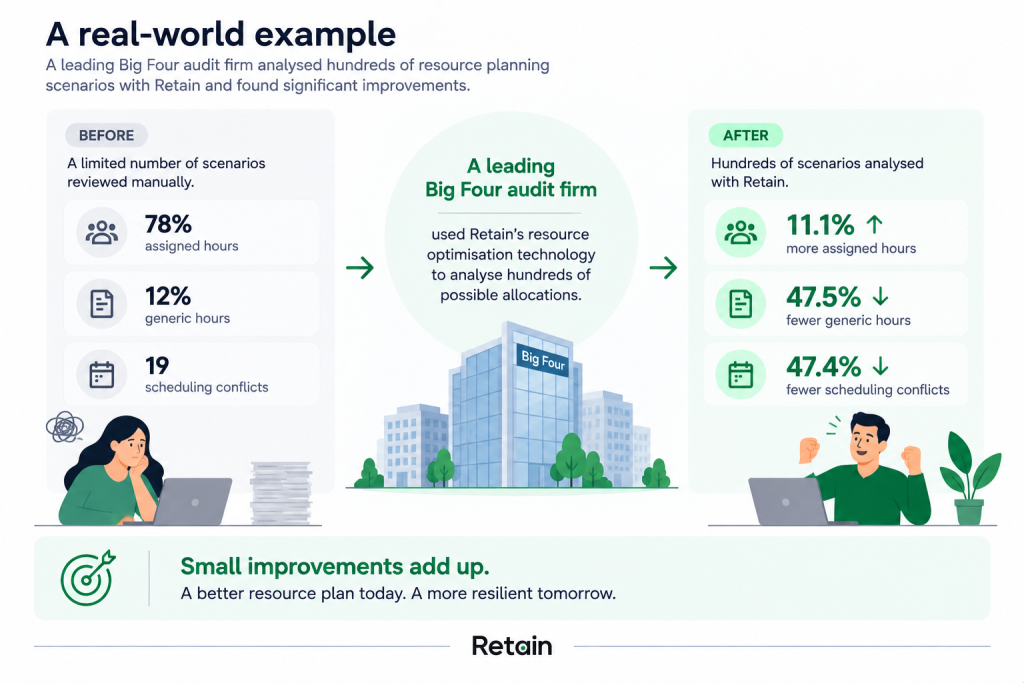
For one leading Big Four audit firm, it did.
The firm used Retain’s resource optimisation technology ahead of a busy planning period, analysing far more possible allocations than its resource team could realistically work through manually.
And the results were pretty impressive:
- 11.1% more assigned hours
- 47.5% fewer generic hours
- 47.4% fewer scheduling conflicts
Think about what that means across a large resource plan. A better allocation for one person might only make a small difference. Find those opportunities across hundreds or thousands of assignments, and those small improvements can add up fast.
How Retain MatchingCore approaches resource optimisation
So, how do you go from comparing a handful of scenarios to comparing hundreds?
That’s where Retain MatchingCore comes in. It uses AI to analyse your complete resource plan and work through hundreds of possible planning scenarios in minutes.
Here’s how it works:
- Choose your objective. Want to improve resource fit, reduce cost or get the right grade mix? Pick the priority you want MatchingCore to focus on.
- Let MatchingCore analyse the plan. It works through possible allocation combinations across your complete resource plan.
- See how the options stack up. Compare the results across KPIs such as utilisation, assigned hours, resource fit, conflicts and cost.
- Bring in your team’s expertise. Resource managers review the recommendations and add the business context and experience we talked about earlier.
- Choose your plan. Once you’re happy with an option, approve it and apply the changes in Retain.
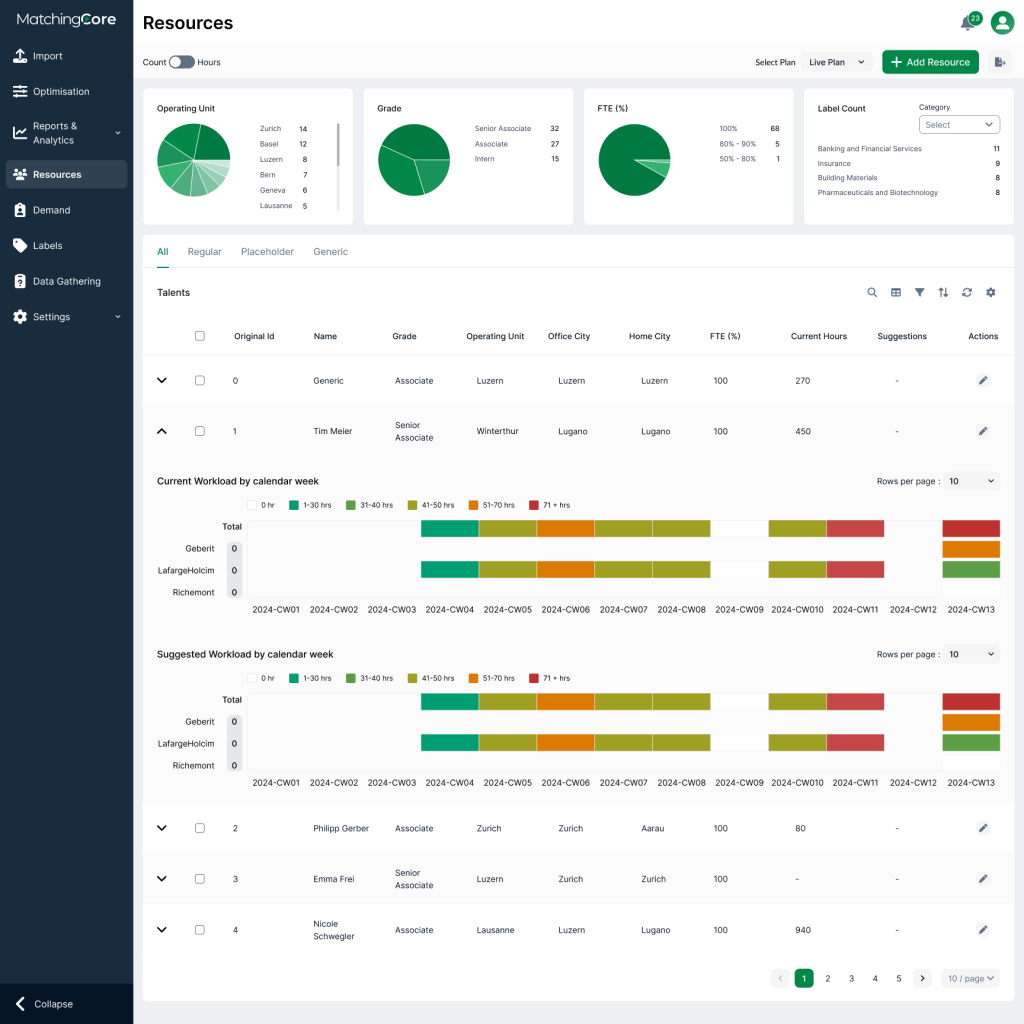
The result? Your resource managers get hundreds more possibilities to consider, without having to build and test every scenario themselves. And they still make the final call.
How many possibilities are you considering?
Five scenarios? Ten? Twenty?
However experienced your resource team is, there’s a limit to how many options they can realistically build and review. AI-powered resource optimisation changes the scale, giving them hundreds of possibilities to consider.
And somewhere in those hundreds could be a better skills match, fewer scheduling conflicts, lower delivery costs or a stronger use of the capacity you already have.
Retain MatchingCore analyses hundreds of resource planning scenarios in minutes, giving your team more options to consider before they make the final call.
So, what could it find in your resource plan?
See Retain MatchingCore in action
Frequently Asked Questions
A resource planning scenario is one possible version of how people could be allocated across projects or work. Teams can create different scenarios to see how changes to assignments affect areas such as availability, utilisation, cost and skills coverage.
There isn’t a fixed number. The aim is to compare enough options to make a well-informed decision. For large organisations, the number of possible allocations can quickly reach far beyond what a resource planning team has time to review manually.
Resource optimisation is the process of finding effective ways to allocate people based on your business priorities and constraints. These might include skills, availability, grade, utilisation, cost and existing assignments.
AI can analyse large numbers of possible allocations and assess them against defined objectives. This gives resource managers more options to review without requiring them to create every possible scenario themselves.
No. Resource managers bring knowledge and context that software may not have, from client relationships and team dynamics to development opportunities. AI can help with the analysis, while the resource manager reviews the options and makes the final decision.
Our editorial process
Written from interviews with resource managers in IT consulting firms, alongside anonymised patterns from Retain customer data. Direct quotes are used with permission and lightly edited for length.
Reviewed for accuracy by Retain’s resource management practice leads before publication. Claims about outcomes are checked against source data or removed.
The summary at the top of this page is generated from the article text. The article itself is written and edited by people. AI is not used to draft claims, quotes or data.
Spotted something wrong? Email editorial@retaininternational.com and we will correct it, noting the change at the foot of the article.