Want to improve resource utilisation in your professional services firm? You could start by asking everyone to bill more hours. But if your busiest consultants are already stretched while others have gaps in their schedules, that’s unlikely to get you very far at all.
The best opportunity is in understanding where capacity is being lost and what you can do to recover it.
From smarter forecasting and skills-based scheduling to reducing bench time, we’ll delve into eight ways to improve utilisation, increase billable capacity, and keep workloads manageable.
Too busy for the full read? Here’s the summary:
That’s the short version. Now let’s get into the useful stuff. ↓ |
Diagnose why utilisation is low before choosing a fix
Before you start chasing a higher utilisation rate, it’s worth finding out where those missing hours are going. Because the fix for a consultant sitting on the bench will look very different from the fix for someone spending half their week on internal admin.
And here’s where things get tricky.
Your firm might have a perfectly respectable average utilisation rate, while some teams are overloaded and others are struggling to fill their schedules. Averages can hide a lot.
Let’s look at an example. Here, the firm-wide figure looks healthy. The team-level view? Not so much.
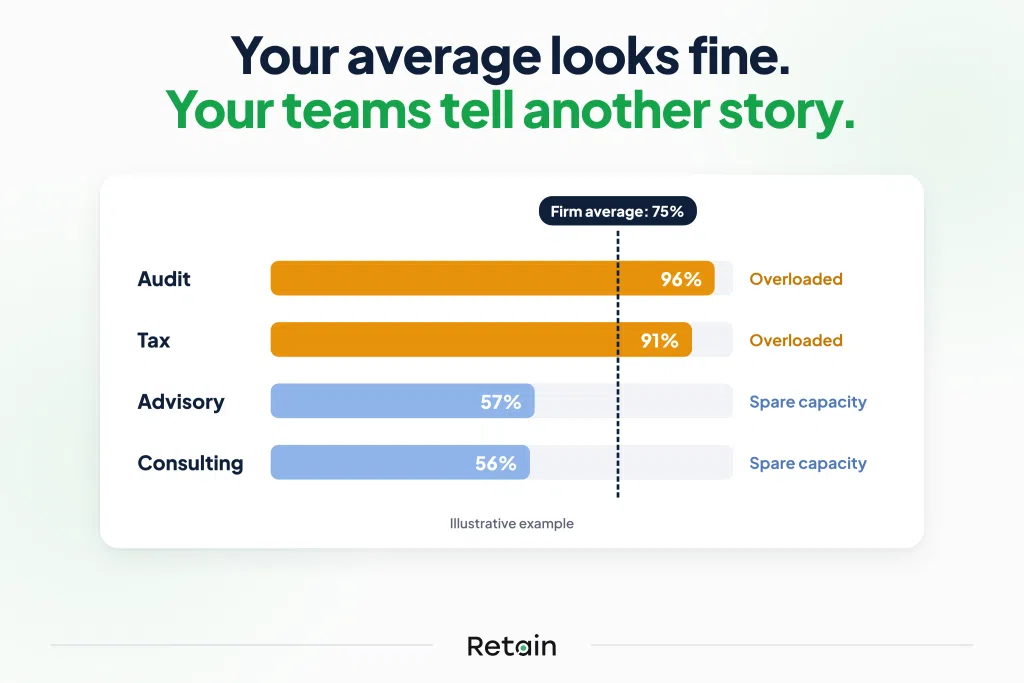
That’s why, often, the best place to start is by looking at utilisation across teams, grades, and individuals, alongside your pipeline, project schedules, and non-billable hours. (You’ll soon get a clearer idea of what’s causing the gaps.)
Common causes of low resource utilisation (and what to do about them)
| What you’re seeing | Likely cause | Where to start | KPI to watch |
| Consultants spending too much time on the bench | Poor demand or skills visibility | Improve pipeline forecasting | Bench time % |
| High levels of non-billable work | Admin, internal meetings, or unrecorded time | Review where time is going | Non-billable hours |
| Last-minute staffing gaps | Reactive resource planning | Forecast demand earlier | Forecast accuracy |
| Busy specialists while others have spare capacity | Skills mismatches | Match people to work based on skills and availability | Utilisation by skill |
| Peaks in overtime followed by quiet periods | Seasonal demand or leave clusters | Plan capacity around busy periods | Overtime hours |
| High billable hours but disappointing returns | Rework, write-offs or inefficient delivery | Review project performance | Realisation rate |
One thing worth remembering: low utilisation doesn’t always mean you have too many people. You might have plenty of work available, with the wrong mix of skills, poorly timed assignments or limited visibility across departments.
So it’s worth looking beneath the headline percentage before deciding what needs to change.
➡️ For a closer look at how the figures can hide delivery risks, read our guide to why utilisation numbers can mislead.
What is one percentage point of utilisation worth?
One percentage point doesn’t sound like much. Across a few hundred consultants, though, it can represent a pretty substantial amount of potential revenue.

Say your consultancy has 200 consultants, each with 1,500 available working hours per year. That’s 300,000 hours of total annual capacity.
Improving billable utilisation by just one percentage point would free up an additional 3,000 hours for billable work.
At an average billing rate of £150 per hour, that’s: 3,000 hours × £150 = £450,000 in potential additional annual revenue.
And that’s from a single percentage point.
Here’s the formula you can use with your own figures:
Value of 1 point = Available hours × 1% × Average rate
Of course, these figures are illustrative. To turn those additional hours into revenue, you’ll need sufficient client demand, suitable work for the people available, and the ability to bill and collect at your assumed rate.
Still, it’s a useful exercise for finance and resource leaders. Even a relatively small improvement in utilisation could represent a significant commercial opportunity, especially when you multiply it across an entire firm.

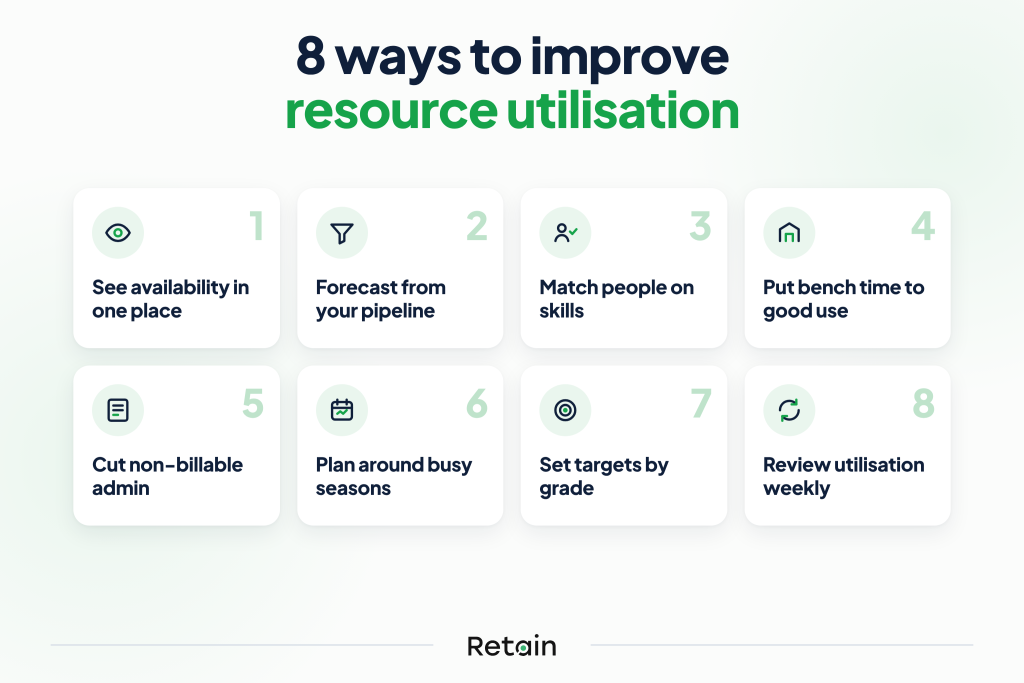
8 ways to improve resource utilisation in professional services
You’ve identified where capacity is being lost and what even a small improvement could be worth. Now it’s time to do something about it.
Here are eight practical ways to improve resource utilisation, starting with getting a clearer view of the people and work you already have.
1. See availability and demand in one place
It’s hard to make the most of your people when you can’t see who’s available. And in larger professional services firms, information can be scattered across spreadsheets, project plans, calendars, and different departments. By the time you’ve pieced everything together, the situation may have already changed.
Bringing availability, existing bookings, and upcoming demand into one place makes it easier to spot gaps and allocate people more effectively.
For example, your London consulting team might be struggling to staff a project while someone with exactly the right experience has spare capacity in Manchester. (Without visibility across offices, that opportunity could easily be missed.)
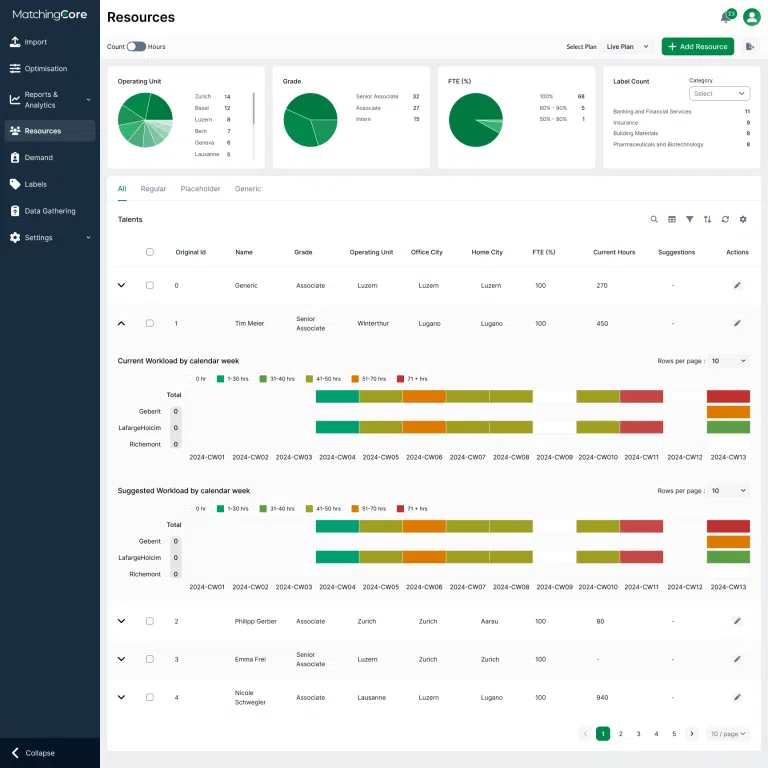
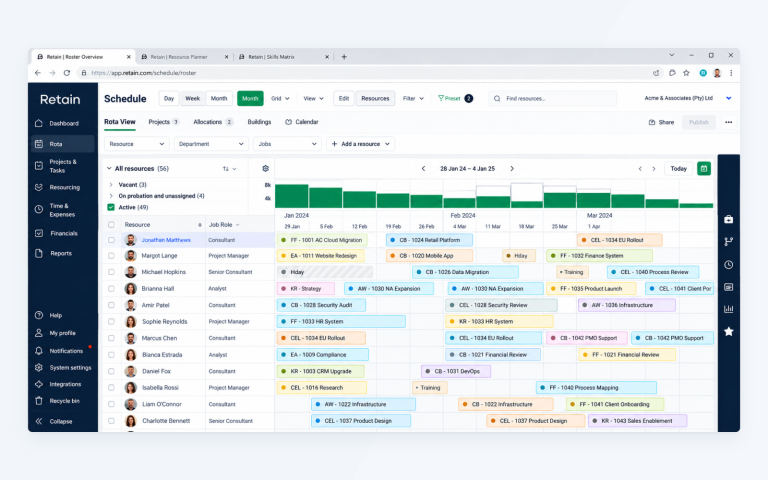
This is where resource management software like Retain can help. With a shared view of resource availability, bookings, and capacity across teams and offices, managers can identify underused resources and make better allocation decisions.
What to measure: Bench time, unallocated capacity, and utilisation by team or office.
2. Forecast demand from your pipeline, not just confirmed work
Your sales pipeline can give you an early indication of the skills and capacity you’ll need in the coming months. By factoring in likely projects, expected start dates, and their probability of going ahead, you can build a more realistic picture of future demand.
Say your consultancy has three large opportunities likely to start in September. Even if none are confirmed, you can start assessing whether you’ll have the right people available. You can also compare forecast demand against capacity and utilisation targets to identify potential revenue gaps or staffing shortages earlier.
Retain’s capacity planning software helps firms forecast resource requirements and identify potential capacity gaps, giving teams more time to plan their next move.
What to measure: Forecast accuracy, future capacity gaps, and forecast utilisation against targets.
3. Match people to projects based on skills, not job titles
Two consultants might have the same job title and completely different areas of expertise. One could have years of experience implementing SAP systems, while the other specialises in cybersecurity. Both might be available next Tuesday, but that doesn’t make them equally suitable for the same project.
Matching people based on their skills, experience, proficiency and availability helps you make better use of existing expertise. It can also reduce rework, avoid unnecessary reliance on a handful of specialists, and uncover capabilities elsewhere in the business.
Of course, this depends on having accurate skills data in the first place.
Retain’s skills management capabilities include a taxonomy of over 30,000 skills, while its AI-powered MatchingCore helps resource managers identify suitable people for project requirements.
What to measure: Skills-related staffing gaps, rework, and utilisation across different skill groups.
4. Put bench time to better use
A little bench time is inevitable in professional services. Projects finish, new ones get delayed, and demand fluctuates. The trick is making sure people aren’t sitting idle when there’s useful work they could be doing.
Start by looking beyond individual teams and offices. Could someone with spare capacity support another department? Are there upcoming projects they could prepare for?
And when billable work isn’t available, use that time deliberately. Training, certifications, and developing skills that match future demand can all be worthwhile investments.
The important thing is to plan ahead. A consultant who’s free for the next three weeks could be developing expertise you’ll need for a major project in six months.
What to measure: Bench time, redeployment rates, and the proportion of available capacity assigned to productive work.
5. Reduce the non-billable work eating into your week
How much of your team’s time disappears into internal meetings, admin, and chasing project updates? An hour here and there might seem harmless. Across 200 consultants, though, saving just one hour per person each week could recover 10,000 hours over 50 working weeks.
That’s a lot of time.
Review where non-billable hours are going and look for opportunities to simplify processes, automate repetitive tasks, and cut unnecessary meetings.
Resource managers can also save time by reducing the manual work involved in finding available people, checking their skills, and coordinating assignments.
Of course, some non-billable work is essential. Training, mentoring, and business development all contribute to the firm’s future success. The aim is to remove avoidable admin and free up more time for valuable work.
For more ideas, read our guide to billable hours in professional services.
What to measure: Non-billable hours by activity, time spent on administration and billable utilisation.
6. Plan around leave, busy seasons, and demand spikes
Anyone who’s worked in accountancy or audit knows that workloads don’t spread themselves neatly across the year. One month, everyone’s flat out. The next? You’re trying to find enough work to keep people busy.
Annual leave, year-end deadlines and overlapping projects can make those peaks and troughs even harder to manage.
The earlier you can see them coming, the more options you have.
Use historical demand, upcoming projects, and planned leave to forecast capacity requirements. Then explore whether work can be brought forward, rescheduled, or shared across teams and offices.
Retain’s capacity forecasting and scenario modelling capabilities can help resource managers assess upcoming requirements and plan for changes in demand.
What to measure: Overtime hours, forecast capacity gaps and utilisation fluctuations throughout the year.
7. Set utilisation targets by grade (and actually review them)
Expecting everyone in your firm to hit the same utilisation target is rarely realistic. A junior consultant might spend most of their time delivering client work, while a partner has business development, client relationships, and team leadership responsibilities to juggle.
Set targets that reflect these differences, then track actual utilisation against them by grade, team and department. This also helps you spot problems that a firm-wide average might hide. One team could be consistently exceeding its target while another is falling short. And don’t forget to review those targets as roles, responsibilities and business priorities change.
What to measure: Actual versus target utilisation by grade and team, alongside overtime and workload distribution.
8. Make utilisation a weekly conversation
You’ve got your utilisation reports. Great. Now, what are you doing with them? A monthly report might tell you that a team was underutilised four weeks ago. By then, the opportunity to recover those billable hours has probably passed.
A short weekly resource review can help you act while there’s still time to make a difference. Bring resource managers, project leads and relevant department heads together to look at who’s available, where demand is building and which assignments need attention.
Keep it focused. Twenty minutes spent identifying upcoming gaps, agreeing actions, and assigning owners could save hours of rescheduling later.
With Retain’s resource management reporting, teams can monitor utilisation, bookings, and availability to support these regular reviews.
What to measure: Changes in utilisation, forecast accuracy, and the number of resourcing issues resolved before they affect delivery.
How to improve utilisation without burning people out
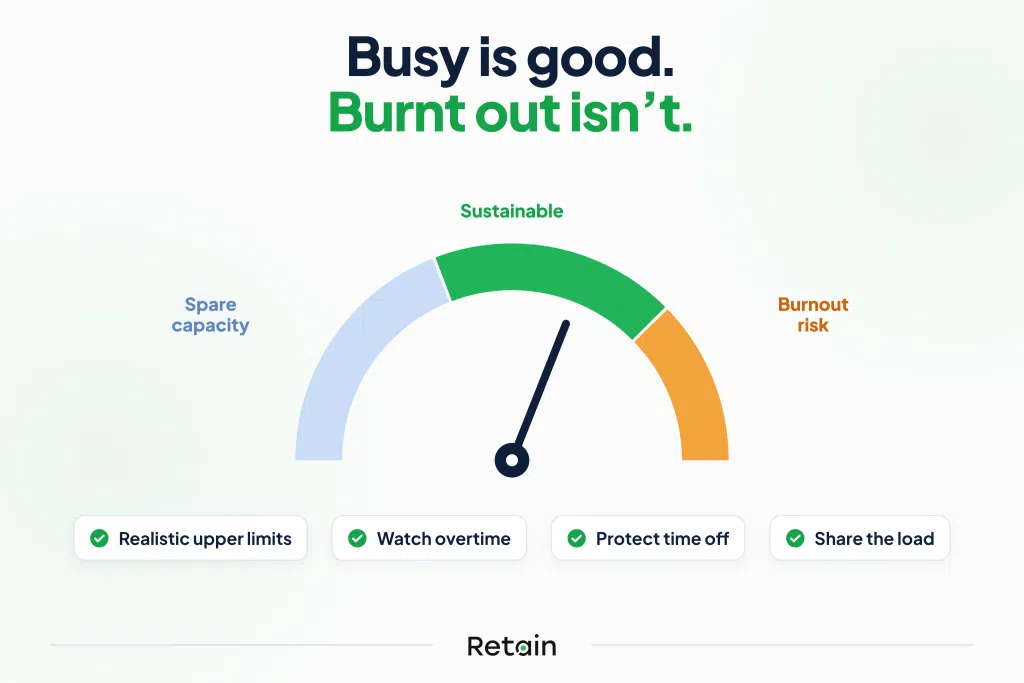
Of course, there’s a limit to how many billable hours you can squeeze into a working week. And if your utilisation strategy depends on everyone working longer hours, you’re going to run into problems.
Overworked consultants are more likely to make mistakes, need time off, or start looking for opportunities elsewhere. Any short-term gains in utilisation could quickly disappear into rework, absence and recruitment costs.
So, how do you improve utilisation while keeping workloads manageable?
A few sensible guardrails can help:
- Set realistic upper limits. Establish utilisation targets that reflect different roles, grades and responsibilities, with enough room for essential non-billable work.
- Keep an eye on overtime. Someone consistently exceeding their target might look productive in a report, but sustained overtime is worth investigating.
- Protect time off and development. Annual leave, training and mentoring should be factored into capacity plans rather than squeezed around billable work.
- Share the workload fairly. Avoid relying on the same high performers for every demanding project. Better visibility into skills and availability can help spread assignments more evenly.
It’s also worth speaking to your people. Utilisation figures can tell you who’s busy, but they won’t always tell you how manageable that workload feels.
➡️ We’ve explored this further in our article on looking after the people behind the utilisation numbers.
Ultimately, improving utilisation should help your firm make better use of its existing capacity while giving consultants a workload they can sustain.
Where resource management technology can help (and where it can’t)
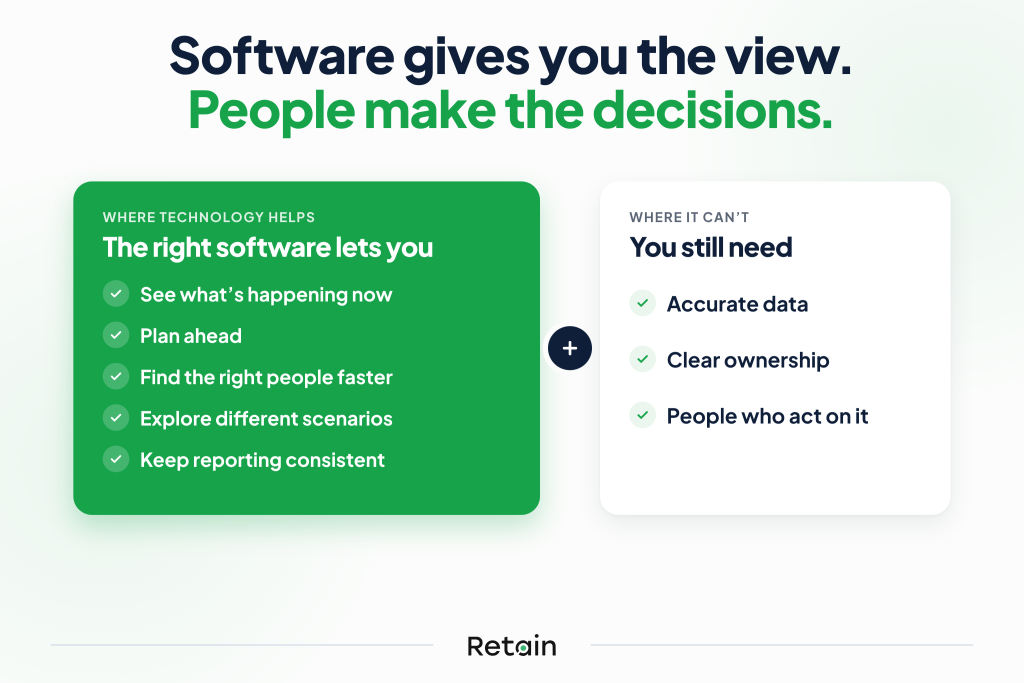
When you’re managing hundreds of consultants across multiple teams and offices, keeping track of everyone’s availability, skills, and workload can become a full-time job in itself.
And if your resource managers are spending hours updating spreadsheets and chasing information, that’s time they could be spending making better staffing decisions.
The right resource management software can make life considerably easier.
Look for a solution that helps you:
- See what’s happening now. Access up-to-date utilisation, availability and bookings without waiting for month-end reports.
- Plan ahead. Compare forecast demand with available capacity and identify potential gaps before they affect revenue.
- Find the right people faster. Search by skills, experience and availability to make better use of expertise across the firm.
- Explore different scenarios. Assess how changing project demand or resource allocations could affect future capacity.
- Keep reporting consistent. Give teams and departments a shared view of utilisation and resource performance.
Retain brings these capabilities together through resource scheduling, skills-based matching, capacity forecasting and resource management reporting.
Of course, even the best software needs accurate data, clear responsibilities and people who act on the information it provides.
Want to see how Retain could help your firm improve resource utilisation? Book a demo.
A practical 90-day plan to improve resource utilisation
You don’t need to overhaul your entire resource management process overnight. Start with the biggest opportunities, make a few targeted changes and build from there.
Here’s how you could approach your first 90 days.
| When | What to do | Who’s responsible |
| Weeks 1–2: Find the gaps | Establish your current utilisation rates by team and grade. Identify bench time, non-billable work, skills gaps and workload imbalances. | Resource managers and finance |
| Weeks 3–6: Make quick improvements | Reallocate available people, address scheduling gaps, reduce unnecessary admin and review upcoming demand. | Resource managers and project leads |
| Weeks 7–12: Make it a habit | Introduce weekly resource reviews, improve forecasting, refine utilisation targets and monitor progress against your baseline. | Operations and department leads |
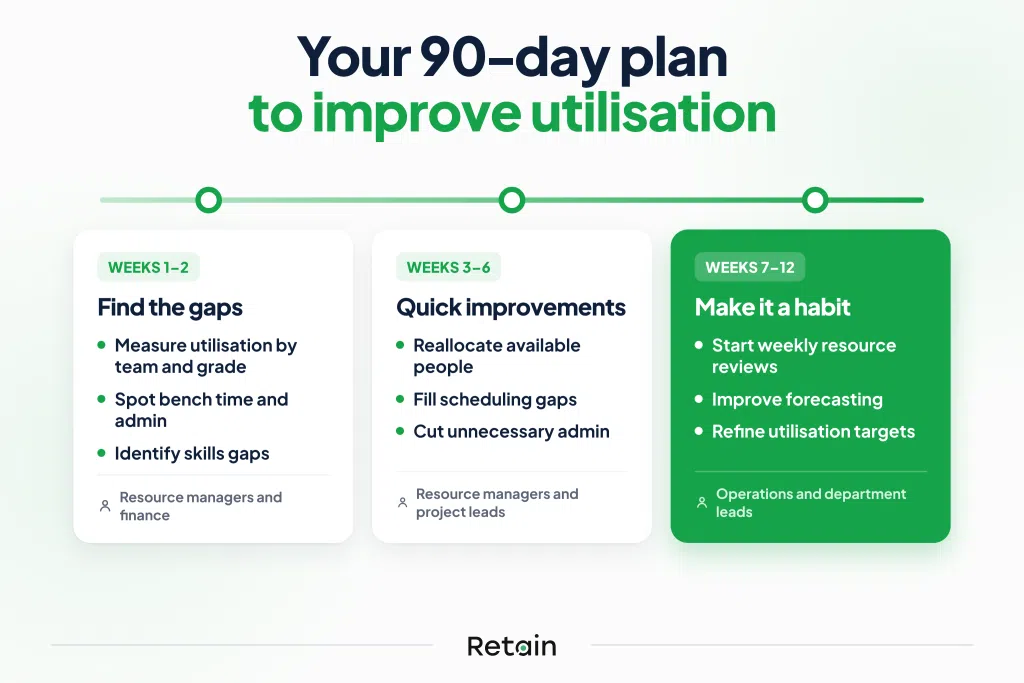
By the end of the 90 days, you should have a clearer view of where capacity is being lost, which changes are working and where further improvements are possible.
And don’t judge success on utilisation alone. Keep an eye on overtime, realisation rates and employee workloads to make sure those extra billable hours are delivering genuine value.
Ninety days won’t solve every resourcing headache. But it’s plenty of time to find some of the biggest ones and start doing something about them.
Ready to make better use of your resources?
Improving resource utilisation starts with understanding where your capacity is going and making smarter decisions about how to use it.
With better visibility, more accurate forecasting and skills-based resource planning, you can reduce wasted capacity, increase billable opportunities and keep workloads manageable.
Retain helps professional services firms put all of this into practice, bringing resource availability, skills, demand and scheduling together in one platform.
Book a demo to see how Retain can help your firm get more from its existing resources.
Looking for more insights? Dive into our library of articles and guides to keep mastering the art of resource management.
Or if you’d like to read our most frequently asked questions, take a look below.
Frequently Asked Questions
Start by identifying where capacity is being lost. Then focus on improving demand forecasting, matching people to projects based on skills, reducing unnecessary non-billable work and reviewing utilisation regularly. Better visibility across teams and offices can also help you make use of available capacity.
Common causes include poor resource planning, gaps between projects, skills mismatches, inefficient scheduling and excessive administrative work. Seasonal fluctuations and limited visibility across departments can also leave consultants underutilised, even when there’s plenty of work elsewhere in the business.
There’s no single target that works for every consultant. Appropriate utilisation rates depend on seniority, responsibilities and the type of work being delivered. Junior consultants may have higher billable targets than partners who spend more time on business development and leadership.
Focus on distributing work more evenly, forecasting demand earlier and matching people to suitable assignments. Set realistic targets, monitor overtime and protect time for annual leave, training and development. Regular conversations about workload can also help identify pressure before it becomes a problem.
Compare your current resource utilisation rates with a consistent baseline, using the same calculation method and reporting period. Track results by team and grade, alongside bench time, overtime and realisation rates.
Our editorial process
Written from interviews with resource managers in IT consulting firms, alongside anonymised patterns from Retain customer data. Direct quotes are used with permission and lightly edited for length.
Reviewed for accuracy by Retain’s resource management practice leads before publication. Claims about outcomes are checked against source data or removed.
The summary at the top of this page is generated from the article text. The article itself is written and edited by people. AI is not used to draft claims, quotes or data.
Spotted something wrong? Email editorial@retaininternational.com and we will correct it, noting the change at the foot of the article.