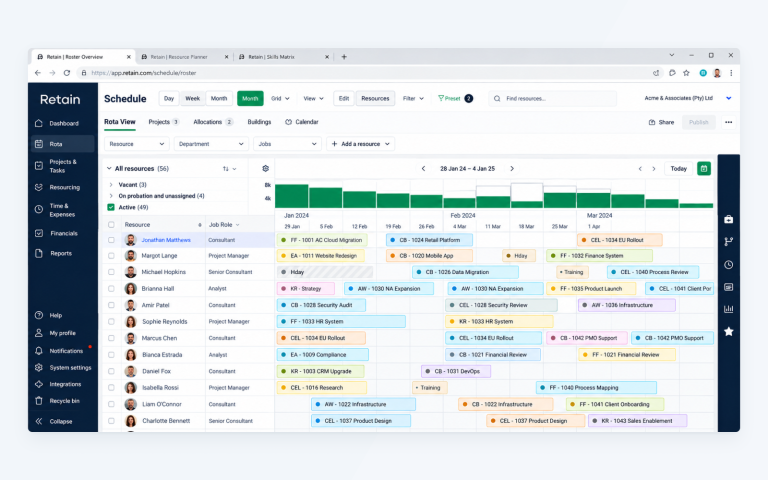
Your strategic workforce planning can look great at first glance. You have the headcount and the skills, and you’ve modelled what the business will need. Then you try to resource the work.
The skills are there, but the people aren’t available. Your most experienced people are already stretched. The same specialists keep getting requested. And suddenly you’re hiring contractors to fill a capability you supposedly already have.
This is where workforce planning is put to the test. Day-to-day resourcing problems test the assumptions behind your workforce plan against what’s actually happening in the business. I believe we need to pay much more attention to that feedback loop, especially as AI changes the work we do and where human capacity can create the most value.
Your workforce plan needs a feedback loop 🔄In a rush? Here are the key points:
Want to know what your resource data could be telling you about your workforce plan? Keep reading ⬇️ |
The missing link between strategic workforce planning and resource management
Strategic workforce planning tends to start with the future. It looks at what work we are expecting, which capabilities we will need, and where we might need to hire, develop, or redeploy people.
Resource management deals with what happens next.
This makes resource data incredibly useful to workforce planners.
In a recent study*, nearly 9 in 10 organisations use resource management data to inform strategic decisions, but only 19% say it is central to strategic planning.
According to the same report, one resource manager says; “Resource management touches revenue, delivery quality, employee experience, and client outcomes, yet is frequently excluded from strategic conversations.”
And that’s a problem.
Say your workforce plan shows plenty of data engineering capability. Six months later, the same small group of experienced data engineers is repeatedly overbooked, projects are competing for their time, and several teams are bringing in contractors.
That tells you something your original workforce data couldn’t.
The useful bit is feeding that information back into the plan.
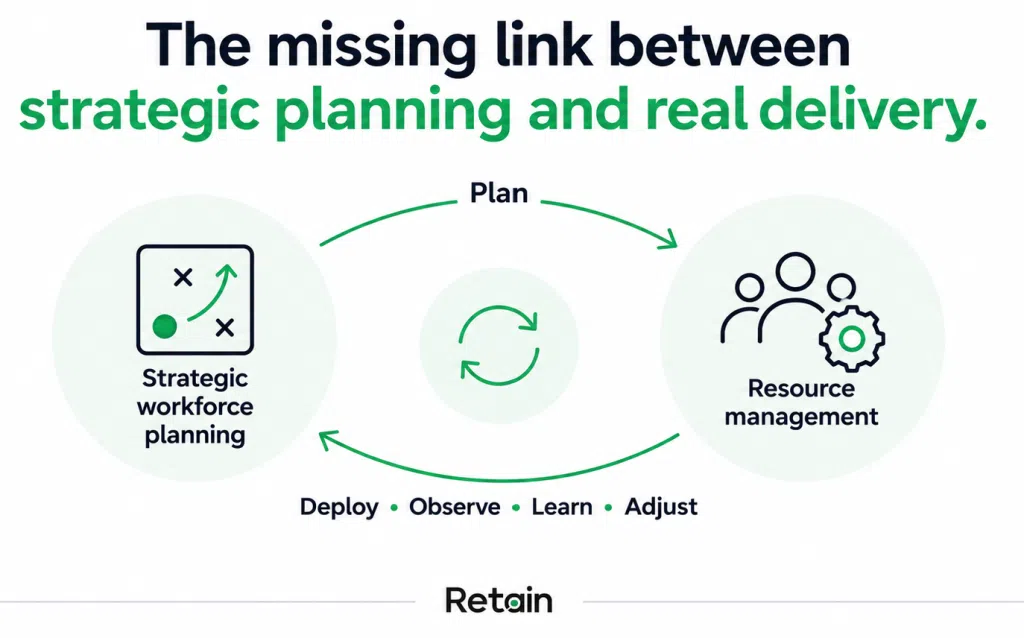
Plan → deploy → observe → learn → adjust 🔄
I like to think of it as a continuous operational feedback loop. Strategic workforce planning gives resource teams direction on the capabilities the business expects to need. Resource management provides evidence of how those assumptions hold up when actual demand comes in.
Do that continuously, and your workforce plan can learn from the way work is really being delivered, instead of waiting for the next planning cycle to catch up.
A skills inventory can only tell you so much
Knowing which skills you have is a great start, knowing if you can use them when demand hits is much more useful.
Someone might have a skill listed on their profile, but when did they last use it? At what level? Are they available? Are they in the right location? Or are they already committed to another priority for the next six months?
This is the difference between theoretical capability and deployable capability.
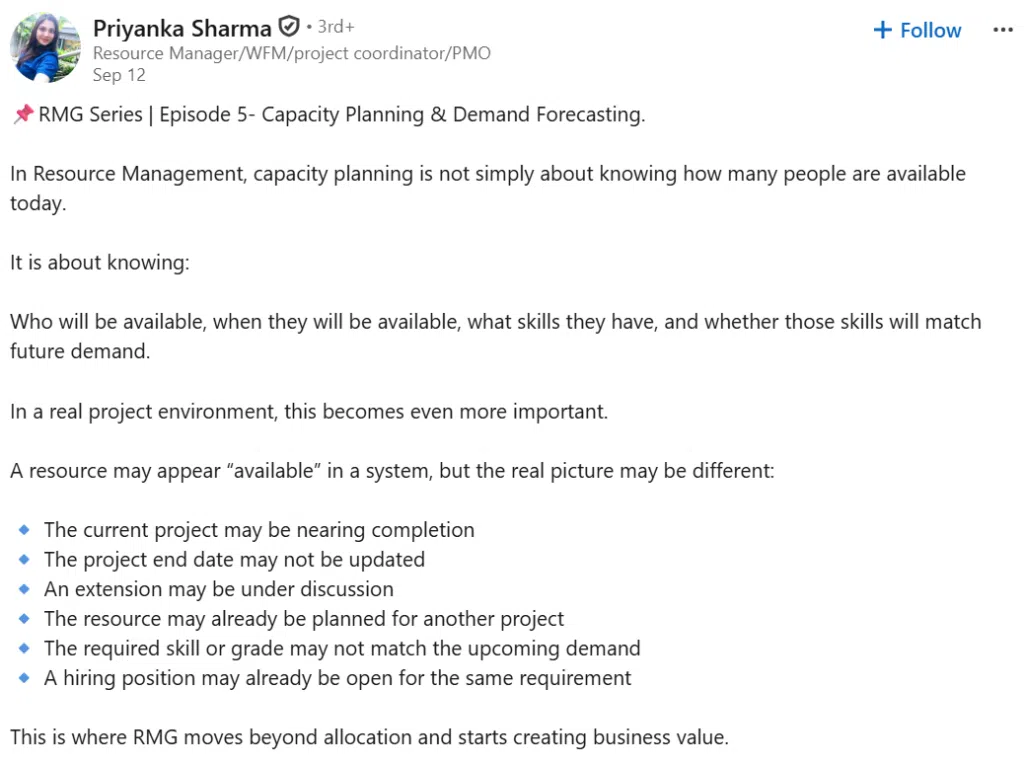
Resource management practitioners are seeing the same issue. Priyanka Sharma recently pointed out on LinkedIn that someone who appears “available” may already have an extension under discussion, be planned onto another project, or lack the skill or grade the upcoming work requires.
I’ve seen organisations discover this the hard way. They think they have enough of a particular skill. But when the work comes in, they find themselves moving people around at short notice, escalating resourcing decisions or bringing in contractors to keep delivery moving.
That’s why skills data becomes much more valuable when you connect it with proficiency, recent experience, availability, existing commitments, and future demand.
Essentially, it tells you whether the capability you’re counting on will actually be there when you need it.
Your resource data may spot workforce problems first
Workforce problems don’t appear overnight. There are usually clues in the way people are being deployed long before they become a hiring crisis or delivery issue.
Perhaps the same specialists keep getting overbooked. A team regularly needs contractors to meet demand. People are being moved between projects at short notice. Or work keeps getting delayed while someone hunts for the right combination of skills and availability.
In fact, Deloitte’s recent report on the Future of Workforce Planning says; 71% of workers already perform work outside their job description. Only 24% say they do the same work as people with exactly the same job title and level.
These can all be early indicators that something in the workforce plan needs another look.
And the commercial impact can add up. Reactive contractor spend can eat into margins. Scarce skills can become delivery bottlenecks. And underused capability elsewhere in the business can go unnoticed while teams recruit externally.
That’s why I’d encourage workforce planners to look at resourcing workarounds as data, rather than isolated operational problems.
Deloitte’s report goes on to talk about the importance of moving from job based planning to more flexible planning based on skills and work.
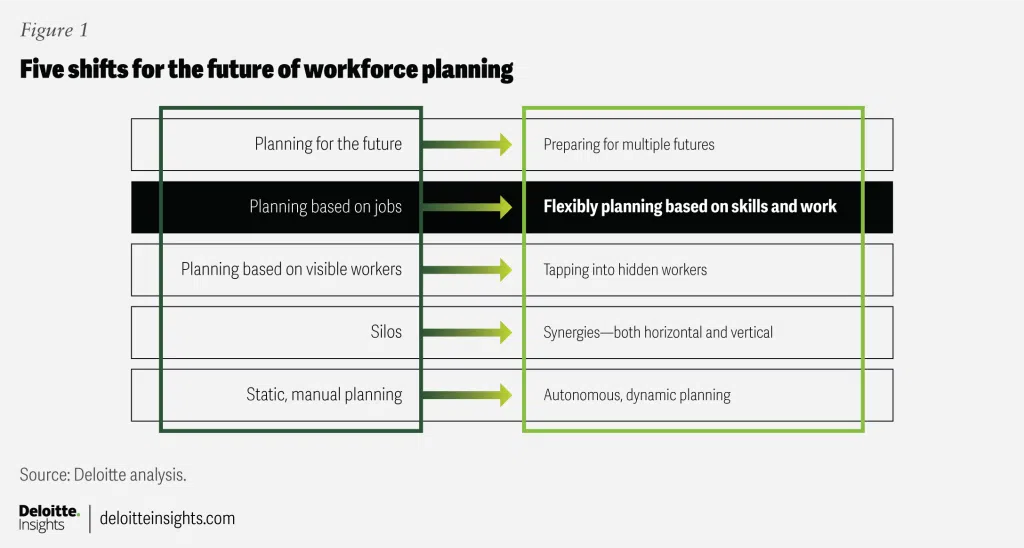
It says, task- and skills-based approaches to workforce planning can grant organisations an additional level of detail to refine their approach and home in on their critical needs. More organisations are recognising the value of this approach.
Give your workforce plan a baseline and a beat rate
Of course, for an operational feedback loop to work, you need something to compare reality against. I like to think of this as establishing your workforce baseline and beat rate. Essentially, this is to understand what normal looks like for your organisation.
It means understanding things like typical demand, seasonal peaks and troughs, the skills different types of work require, how much effort they take, where scarce capabilities tend to crop up, and which bottlenecks keep coming back.
The quality of your demand data is really important here. If you’re only capturing confirmed work, or recording demand inconsistently across teams, it’s going to be difficult to build a reliable view of what you’ll need next.
Once you have that baseline, resource management gives you a regular pulse check against it.
Demand running higher than expected? A particular skill becoming harder to find? More contractor support creeping in? You can spot where reality is starting to diverge from the plan and decide whether to hire, develop, redeploy or rethink how the work gets done.
Hire, develop, redeploy, or automate?
Spotting a future capacity or skills issue is useful. But deciding what to do about it is where workforce planning earns its keep.
Hiring is one option. But so is developing someone with adjacent skills, redeploying capability from elsewhere in the business, using external resources, or changing how the work gets done.
The right answer depends on more than the size of the skills shortage.
What does future demand look like? Is the capability needed regularly enough to justify hiring? Could someone already in the business develop it relatively quickly? What would contractor support cost? And what are the implications for revenue, margin, delivery, and client experience?
These are commercial allocation decisions as much as workforce decisions.
For me, the bigger question is: where can our human capability create the most value?
That becomes particularly interesting when we add AI into the mix. Because if technology starts releasing capacity from existing work, we need to decide what we want people to do with it.
And that’s where I think strategic workforce planning is heading next.
AI turns workforce planning into a capacity decision
As AI takes on more tasks, workforce planners will need to understand the time those tasks currently consume, what they cost, and how much human capacity could realistically be released.
Then comes the important bit: what do you do with that capacity?
If AI saves a team 500 hours, those hours don’t simply disappear from the workforce plan. They could be redirected towards deeper client work, innovation, quality, growth, risk reduction, or building new capabilities.
According to Deloitte, 82% of organisations recognise the importance of freeing up worker capacity, but only 32% are taking action on it.
That’s a pretty big gap.
And there’s another consideration. Many organisations are still experimenting with AI before its full operating costs are understood. As AI becomes more established, decisions about whether work should be completed by a person, augmented by AI, automated, or handled by an agent will become increasingly commercial.
For workforce planners, that means getting much more precise about tasks, time, cost and value.
Make SWP and resource management one continuous planning cycle
So, what does this look like when you put it all together?
I see strategic workforce planning and resource management as one continuous cycle:
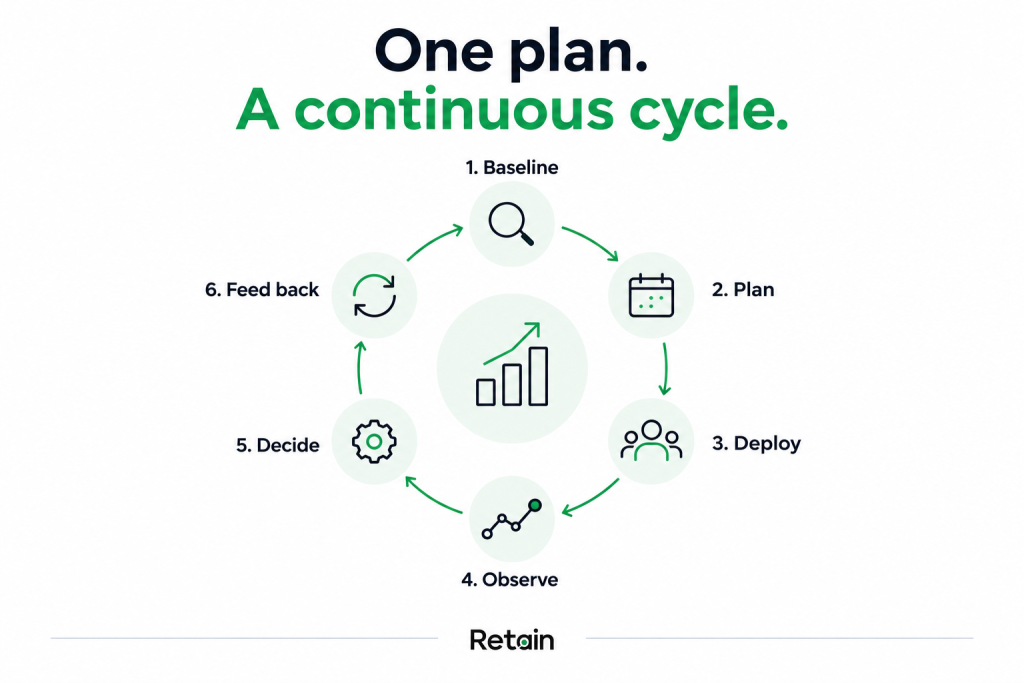
- Baseline: Understand your work, demand, skills, and available capacity.
- Plan: Model what you’re likely to need and test different scenarios.
- Deploy: Match people and skills to actual demand.
- Observe: Watch for bottlenecks, workarounds, and changes in how capacity is being used.
- Decide: Hire, develop, redeploy, use external capacity, or automate.
- Feed back: Use what you’ve learned to update your workforce assumptions.
Then go around again. 🔄
The important part is the connection between the two disciplines. SWP gives resource management a view of where the business is heading. Resource management tells SWP whether those assumptions are holding up as the work gets done.
That’s what keeps the workforce plan live.
Your workforce plan should keep learning
No workforce plan is going to predict perfectly what the business will need six months, a year, or three years from now. Nor should we expect it to. What we can do is get much faster at learning when our assumptions no longer match reality.
That’s the real value of connecting strategic workforce planning with resource management. Every project staffed, skill requested, bottleneck encountered, and workaround made gives us more information about the workforce we actually need.
Feed that intelligence back into the plan, and workforce planning becomes something the business can use continuously, rather than revisit periodically.
The smartest workforce plan may simply be the one that learns fastest.
Retain brings skills, capacity, demand, and resource allocation together, helping organisations spot emerging constraints, make better workforce decisions and keep their plans connected to the work being delivered.
Discover how Retain Cloud supports smarter resource planning →
P.S. Did you know? We cover topics like this regularly. Our free ebooks and webinars go deeper, and you can follow us on LinkedIn for the latest insights.
*Runn, State of Resource Management 2026
Our editorial process
Written from interviews with resource managers in IT consulting firms, alongside anonymised patterns from Retain customer data. Direct quotes are used with permission and lightly edited for length.
Reviewed for accuracy by Retain’s resource management practice leads before publication. Claims about outcomes are checked against source data or removed.
The summary at the top of this page is generated from the article text. The article itself is written and edited by people. AI is not used to draft claims, quotes or data.
Spotted something wrong? Email editorial@retaininternational.com and we will correct it, noting the change at the foot of the article.