

Engineering capacity planning can get complicated… fast. For engineering consultancies and engineer-to-order manufacturers, the same engineers are often needed for customer projects, internal R&D, and upcoming bids. And somehow, all three need to keep moving.
The challenge? Having enough engineers across the business doesn’t mean you have the right skills available when you need them.
And finding those skills isn’t getting any easier. According to the IET’s 2025 UK Engineering and Technology Skills Survey, 76% of engineering employers struggle to recruit for key roles. Which is all the more reason to make the most of the expertise you already have.
In this guide, we’ll look at how engineering firms can plan capacity across all three demands, spot shortages early, and make better staffing decisions before they become expensive problems.
Short on time? Here’s the gist:
Or if you’re ready to get started with resource planning software for engineering firms, you can see it for yourself in a personalised demo. |
What is engineering capacity planning?
Engineering capacity planning helps engineering firms work out how much time and expertise they have available, and if it’s enough to deliver their upcoming work. It helps engineering firms spot skills shortages, balance workloads, and plan ahead across customer projects, internal R&D, and upcoming bids.
Sounds straightforward enough. (Until you start looking at who can actually do the work.👀)
You might have 200 spare engineering hours next month. Which is all well and good. But if your mechanical engineers are already fully booked and you’ve got a major mechanical engineering project coming up, those spare hours won’t get you very far.
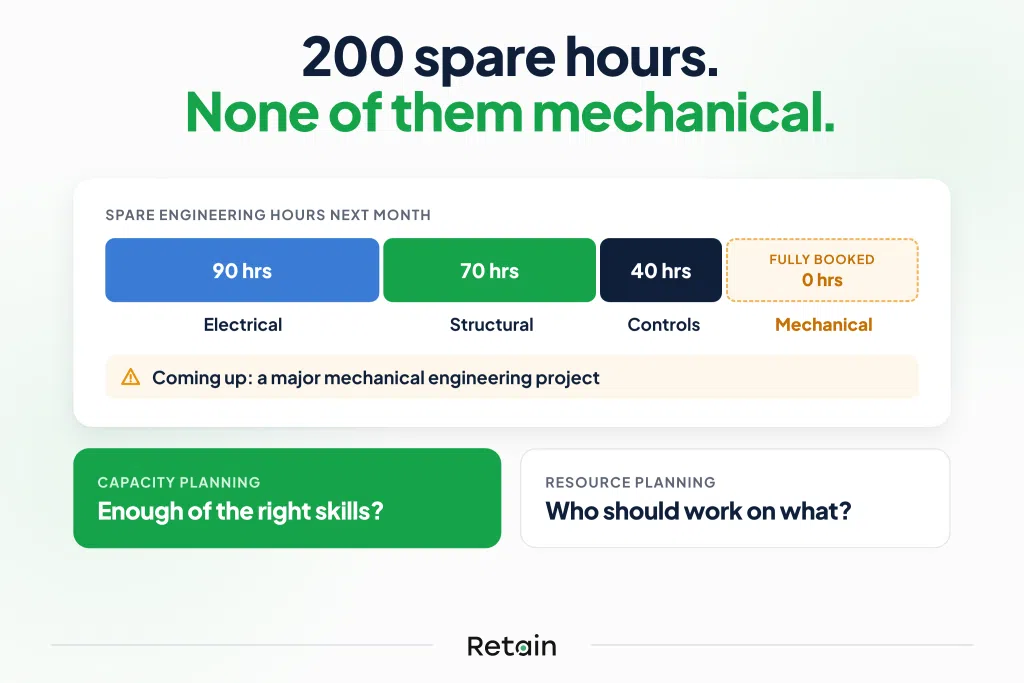
That’s why it’s worth understanding the difference between capacity planning and resource planning.
- Capacity planning tells you if you have enough people with the right skills to meet demand.
- Resource planning helps you decide who should work on what.
And the two go hand in hand, as we explain in our guide to resource capacity planning.

Why engineering capacity breaks when demand has three streams
Customer projects, internal R&D, and upcoming bids all need engineering time. And quite often, they’re competing for the same people. The problem is that each comes with different priorities, deadlines, and levels of certainty. So planning them separately makes it easy to overcommit your engineers.
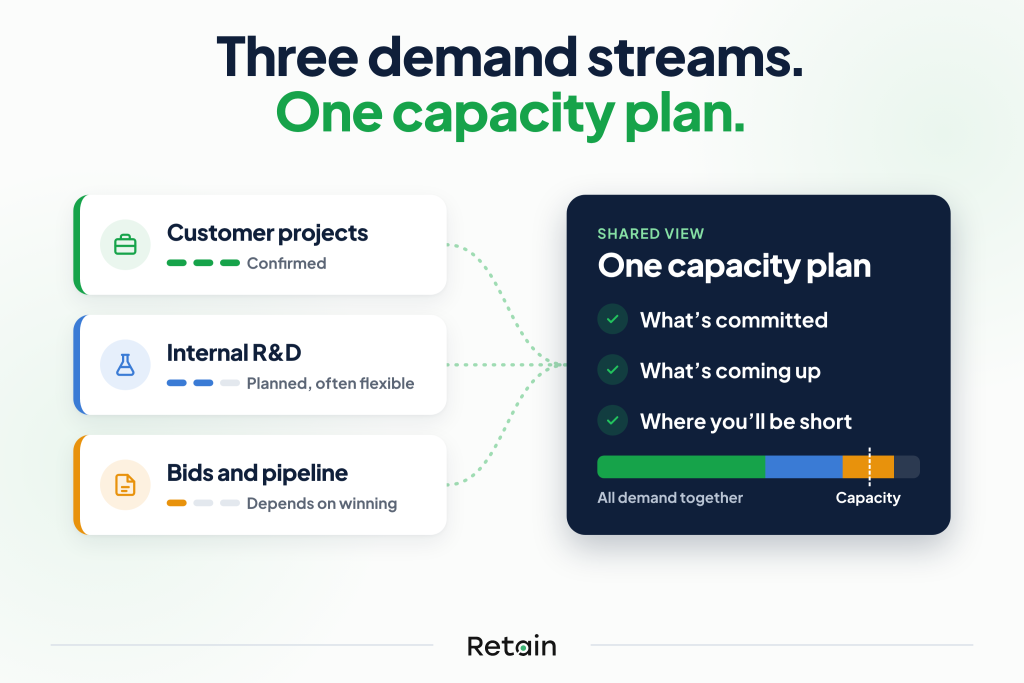
Here’s how the three demand streams typically work:
| Demand stream | Certainty | Typical owner | How it enters the plan |
| Customer projects | High – confirmed work with agreed deadlines | Project manager | Scheduled hours by discipline and project |
| Internal R&D / product development | Planned, but often flexible | Engineering or R&D lead | Allocated development hours |
| Bids / pipeline | Uncertain – depends on winning the work | Sales or bid manager | Forecast demand weighted by win probability |
And this is where things can start to unravel.
A customer project runs late, so engineers get pulled away from R&D. The development schedule slips. Meanwhile, the sales team wins a major contract that wasn’t fully accounted for in the capacity plan.
Suddenly, everyone’s fighting for the same six controls engineers.
The fix starts with bringing all three streams into one capacity plan. That way, you can see what’s already committed, what’s coming up, and where competing demands could leave you short.
This is something you can do straight out of the box with Retain. You can tag customer projects, R&D initiatives, and upcoming bids with custom labels, then filter your capacity plan by work type. You can even save and share these views, so engineering, sales, and project teams are all working from the same information.
How to plan engineering capacity by discipline
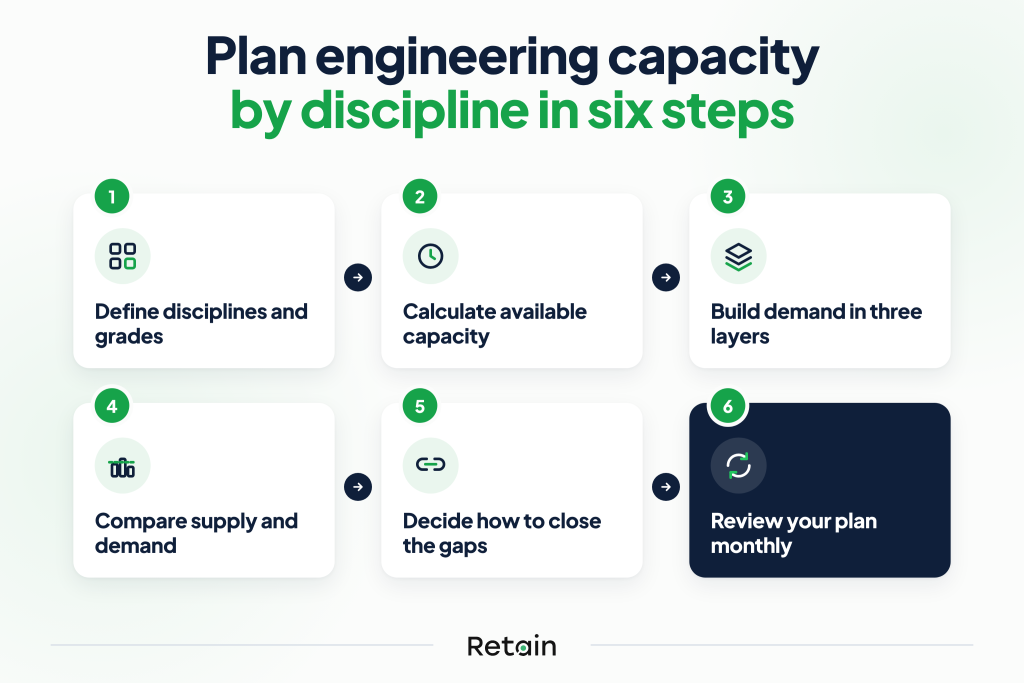
Knowing you’ve got 5,000 engineering hours available next month is a good start. But how many of those hours belong to mechanical engineers? How much controls expertise do you have? And who’s already committed to customer projects?
Here are six steps to build a more useful engineering resource plan:
1. Define your disciplines and grades
Start by grouping engineers by discipline, such as mechanical, electrical, structural, and controls and software. Then break those groups down by grade, skills, and experience. After all, having five junior engineers available won’t necessarily solve a shortage of senior specialists.
And those specialist skills aren’t always easy to replace. In its 2026 Shape of British Industry report, Make UK found that half of UK manufacturers see skills shortages as their biggest barrier to growth.
2. Calculate your available engineering capacity
Work out how many hours each engineer can realistically contribute, accounting for annual leave, bank holidays, training, and other non-project commitments.
Available supply = Number of engineers × Available hours per engineer
For example, 10 structural engineers with 140 available hours each give you 1,400 hours of structural engineering capacity.
3. Build demand in three layers
Next, bring together the engineering hours required for:
- Customer projects: Confirmed work and existing commitments.
- Internal R&D: Planned development and innovation work.
- Bids: Potential work, weighted by the probability of winning.
This gives you a much clearer view of demand by discipline, including work that hasn’t been confirmed yet.
4. Compare supply against demand over 6–12 months
Imagine an engineering firm with 38 engineers across four disciplines. Here’s its capacity position for one month:
| Discipline | Engineers | Supply (hours) | Customer projects | R&D | Bids (weighted) | Balance |
| Structural | 10 | 1,400 | 1,150 | 100 | 150 | 0 |
| Mechanical | 14 | 1,960 | 1,500 | 260 | 120 | +80 |
| Controls and software | 6 | 840 | 700 | 190 | 90 | −140 |
| Electrical | 8 | 1,120 | 800 | 90 | 60 | +170 |
| Firm total | 38 | 5,320 | 4,150 | 640 | 420 | +110 |
Note: these are illustrative figures. Supply assumes 140 available hours per engineer after leave, holidays and non-project time.
Balance = Supply − (Customer projects + R&D + Weighted bids)
At first glance, things look pretty healthy. The firm has 110 spare engineering hours overall. Look a little closer, though, and there’s a problem. Controls and software engineering is 140 hours over capacity, while electrical engineering has 170 hours to spare.
Can those electrical engineers pick up the controls work? Perhaps, if they have the right skills and experience. Otherwise, the firm has a shortage to deal with, despite having spare capacity elsewhere. And that’s exactly why engineering resource capacity needs to be assessed by discipline, instead of relying on company-wide totals.
This is just one month’s capacity. Now imagine tracking the same figures across the next 12 months. You’d be able to see when shortages are likely to emerge and how long they’re expected to last.
5. Decide how to close the gaps
Once you’ve identified a shortage, you can explore your options. Could you move an engineer from another project? Bring forward some work? Find someone with transferable skills? Or will you need additional capacity? The earlier you spot the gap, the more options you have.
6. Review your plan monthly
Engineering schedules don’t stay still for long. Projects slip, bids are won, and priorities change. That’s why it’s key to review supply and demand by discipline each month, looking 6–12 months ahead. Pay particular attention to emerging shortages, changes in engineering resource allocation, and potential resource conflicts.
That way, you’re making staffing decisions with a clearer view of what’s coming, rather than scrambling when the next project starts.
Retain makes this easier with capacity and skills demand reporting. You can forecast supply and demand by engineering discipline, skills, and grade over the next 6–12 months, with daily and weekly capacity trends helping you pinpoint when shortages are likely to occur.

Check capacity before you submit a bid
Winning a major engineering contract is great news. Discovering you don’t have enough engineers to deliver it? Slightly less exciting.
That’s why a pre-bid capacity check is worth doing before you commit to a delivery schedule.
Here’s a simple way to approach it:
- Estimate the engineering hours required. Break the proposed work down by discipline, grade, and delivery dates.
- Check your available capacity. Look at existing customer commitments, R&D allocations, and other likely work during the same period.
- Factor the bid into your forecast. Weight the demand by its probability of being won, so you can plan for a pipeline of opportunities.
- Test the full requirement. Before making a go or no-go decision, check whether you could deliver 100% of the work if you win.
- Decide how to cover any shortfall. Consider recruitment, subcontracting or adjusting project schedules before committing.
What does a pre-bid capacity check look like?
Let’s say an engineering firm is bidding for a project requiring 600 hours of controls engineering across months three to five. The bid has a 40% chance of success, so it adds 240 hours of weighted demand to the firm’s capacity forecast.
So far, so good.
But when the resource manager checks availability across those three months, there’s only 150 hours of spare controls engineering capacity.
That leaves a 450-hour shortfall if the firm wins the contract.
Capacity gap = 600 required hours − 150 available hours = 450 hours
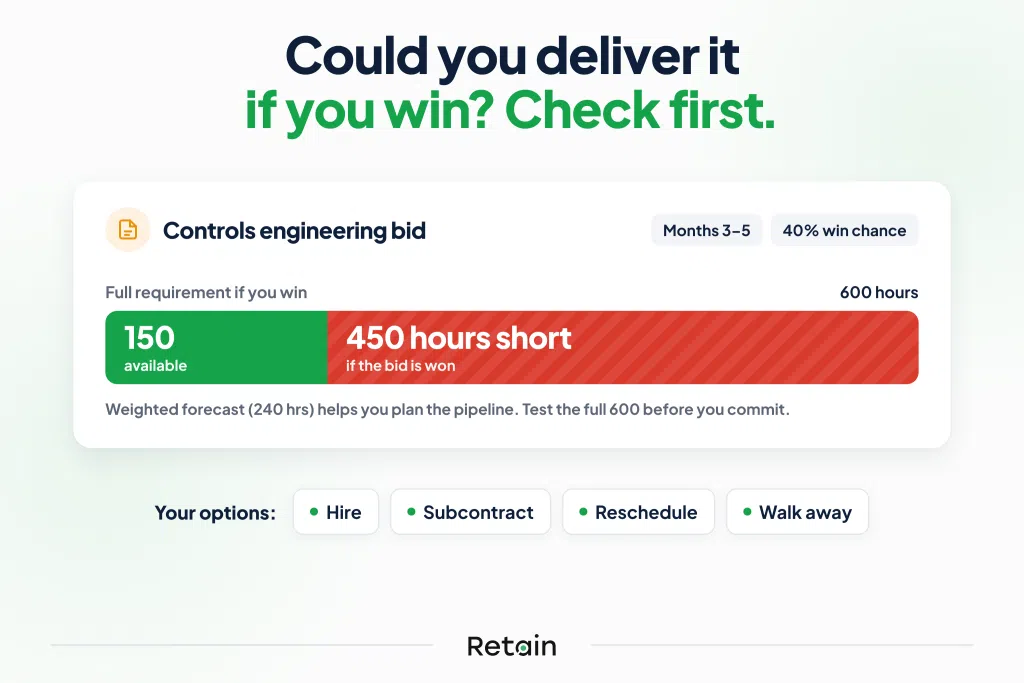
(That’s a pretty big difference to discover after you’ve promised the customer a delivery date.)
With this information upfront, the firm can decide whether to hire, subcontract, reschedule existing work, or walk away from the opportunity.
And if the bid goes ahead, the resource team already knows what needs to happen to deliver it.
With Retain, you can include upcoming opportunities in your capacity plan and view project opportunity percentages in your reporting. (You would calculate weighted demand separately.) Retain’s budgeting feature also lets you explore two planning options side by side, so you can assess the implications of taking on new work before deciding which plan to make live.
Protecting R&D time without starving customer projects
We all know what happens when a customer project starts running behind schedule. Engineers get pulled in to help, priorities change, and suddenly that R&D work scheduled for Thursday has been pushed back. Again.
It’s understandable. But keep borrowing engineers from R&D and those small delays soon add up. Product development slows, innovation projects lose momentum, and the same work keeps slipping down the priority list.
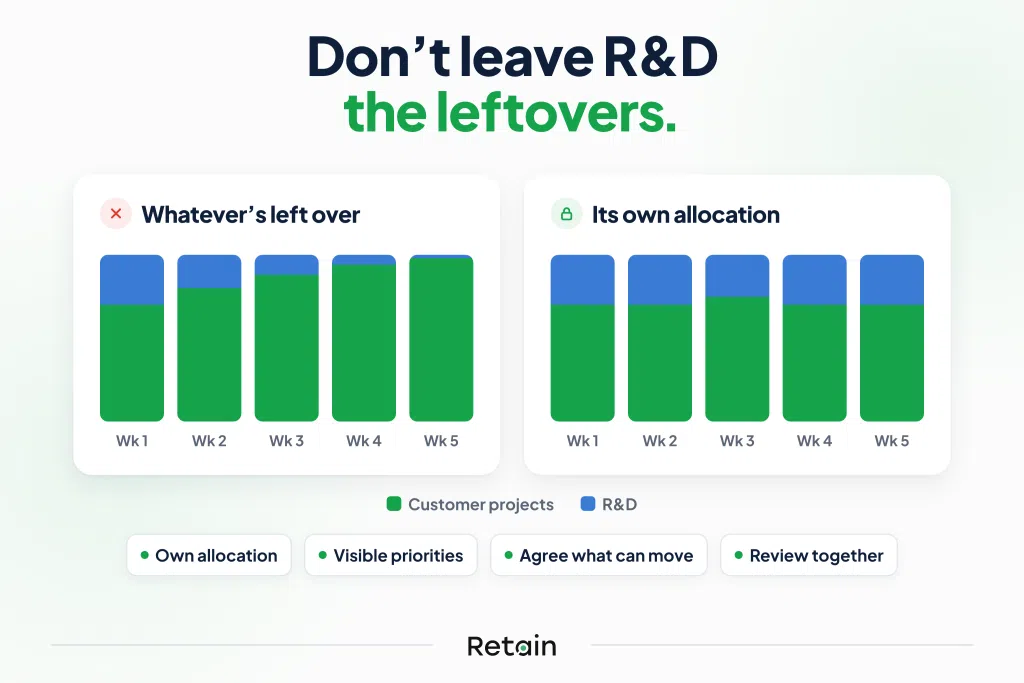
So how do you protect R&D capacity while keeping customers happy?
- Give R&D its own allocation. Treat development work as planned demand, with allocated hours, a budget, and a clear owner.
- Make competing priorities visible. Show R&D commitments alongside customer projects so managers can see the impact of moving engineers around.
- Agree on what can move. Some R&D work will have flexible deadlines. Other projects may have important milestones that need protecting.
- Review changes together. When customer demand increases, assess the knock-on effects before reallocating engineers.
Of course, there will be times when customer work takes priority. That’s business. The aim is to make those trade-offs deliberately, with everyone aware of what gets delayed and by how much. Because if R&D only gets whatever engineering capacity is left over, you can probably guess how much progress it’ll make.
Staffing internal engineers first to cut contractor spend
Contractors can be a lifesaver when a project needs specialist expertise or extra capacity at short notice. But they can also become an expensive habit. Especially when you’ve got engineers elsewhere in the business who could take on the work.
There’s another reason to look closer to home. The IET’s 2025 skills survey found that 50% of engineering employers cite a lack of time as a barrier to upskilling and reskilling.
So making better use of existing expertise, while creating opportunities for engineers to develop new skills, is well worth exploring.
Before bringing in external support, it’s worth checking what your existing team can offer.
Start with the engineers you already have
An internal-first approach to engineering resource allocation means checking a few things before approving contractor spend:
- Skills and experience: Do engineers in other teams or departments have the expertise you need?
- Availability: Could someone with a few spare hours each week help cover the requirement?
- Grade and seniority: Does the work genuinely need a senior specialist, or could a more junior engineer take on some tasks?
- Existing commitments: Could you adjust schedules to free up capacity without putting other projects at risk?
This is where skills-based engineering resource planning can make a real difference.
And it’s a good reason to look for staffing and resource forecasting software for engineering firms that lets you search for available engineers by skills, grade, and capacity across the business.
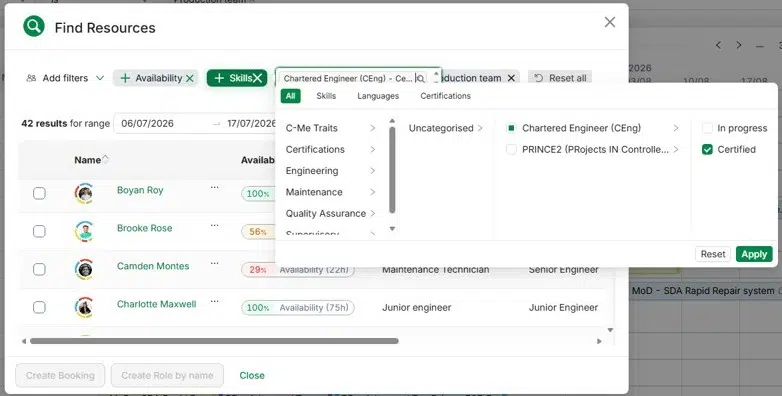
With Retain’s skills framework and resource matching capabilities, you can search for engineers based on their expertise and experience. You might even discover that the specialist you’ve been looking to hire is already working in another department.
Keep an eye on contractor reliance
It’s also worth tracking how much of your engineering workload is being delivered by contractors.
Contractor reliance % = (Contractor hours ÷ Total delivery hours) × 100
For example, if contractors deliver 900 hours out of 6,000 total engineering delivery hours, your contractor reliance is 15%.
Track that figure by discipline and over time. You might discover that one team regularly needs external support while another has underused engineers with relevant skills. Of course, some specialist requirements will always justify bringing in contractors. But every time you can make better use of your existing engineers, there’s an opportunity to reduce costs and keep more expertise within the business.
A portfolio view for monthly steering meetings
When you’re managing engineering capacity across multiple projects, a monthly steering meeting can quickly turn into a long discussion about who’s available, who’s overloaded and which project needs help first.
Sound familiar?
A simple portfolio-level view can make those conversations a lot more productive. Give everyone the same information upfront, and you can spend more time making decisions.
Here’s what your monthly engineering capacity report should include:
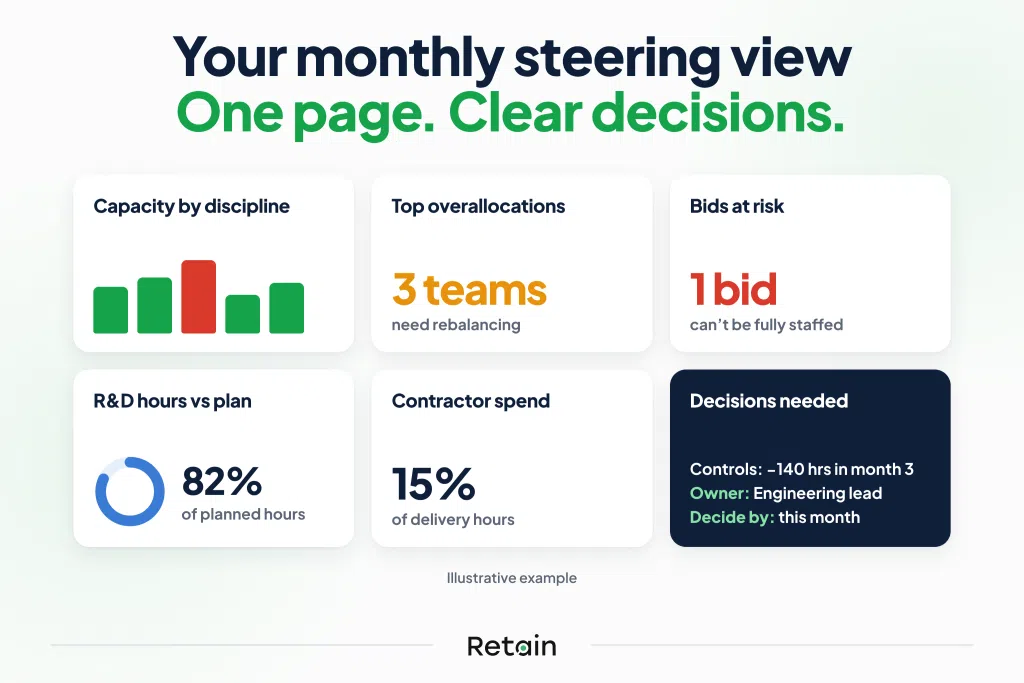
| What to include | What it helps you decide |
| Capacity by discipline | Where are shortages or spare hours emerging over the next 6–12 months? |
| Top overallocations | Which engineers or teams need their workloads rebalanced? |
| Bids at risk | Can we deliver upcoming opportunities if we win them? |
| R&D hours against plan | Is development work progressing, or is customer demand eating into allocated time? |
| Contractor spend | Where could internal engineers reduce our reliance on external support? |
| Decisions needed | What needs approving, changing or escalating this month? |
The important bit? Make sure every capacity issue has an owner and a next step.
If controls engineering is forecast to be 140 hours over capacity in three months, who will resolve it? And when does that decision need to be made?
A good steering meeting should finish with clear actions, whether that’s approving recruitment, moving project dates or protecting R&D time.
Ideally, you’ll spot those issues months before they turn into a last-minute staffing scramble.
And if you’re spending hours pulling together reports before every steering meeting, Retain can help with that too. Its out-of-the-box portfolio reporting gives you visibility of capacity, future demand, and overallocations across multiple engineering projects.
You can also use heatmaps to quickly pinpoint where capacity is tightening and which teams need attention.
What to look for in engineering capacity planning software
Spreadsheets can get you started with engineering capacity planning. But once you’re juggling multiple disciplines, customer projects, R&D commitments, and a growing bid pipeline, keeping everything up to date becomes a lot of work.
The right capacity planning software can make life considerably easier.
Here are five capabilities worth looking for:
- Capacity forecasting by discipline: Can you see supply and demand across engineering disciplines, skills and grades for the next 6–12 months?
- Pipeline visibility: Can you include upcoming bids alongside confirmed customer projects and R&D commitments?
- Skills-based resource matching: Can you quickly find engineers with the right expertise, seniority and availability, including people in other teams?
- Resource conflict alerts: Can you spot overbookings and competing commitments before they disrupt delivery?
- Scenario planning: Can you explore what happens if you win a major bid, delay a project or bring in additional engineers?
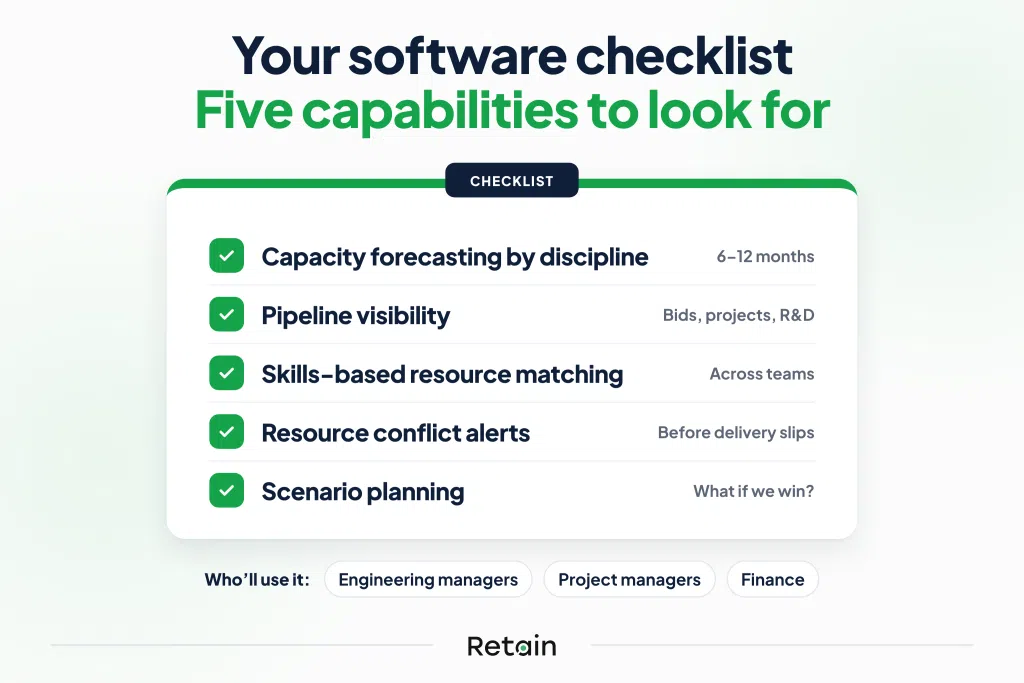
It’s also worth thinking about who’ll use the software day-to-day. Engineering managers need a clear view of capacity, project managers need reliable schedules, and finance teams need visibility into staffing costs.
If you’re comparing options, our guide to engineering resource planning software is a useful place to start.
Where Retain fits in
Managing engineering capacity across multiple disciplines, projects, and competing priorities is a big job. Retain brings all of that information together in one place.
With Retain, you can:
- Forecast capacity by discipline: See supply and demand by engineering discipline, skills, and grade, looking 6–12 months ahead.
- Plan across all three demand streams: View customer projects, internal R&D, and upcoming bids together, with custom labels, filters, and shared workspaces.
- Make better use of existing expertise: Find suitable engineers based on their skills, experience, and availability.
- Explore alternative plans: Use Retain’s budgeting feature to compare two planning options side by side before deciding which to make live.
- Spot emerging capacity issues: Use portfolio reports, capacity visuals, and heatmaps to identify shortages and overallocations early.
Want to see how Retain could support your engineering teams? Explore Retain for engineering firms.
Plan ahead with greater confidence
Engineering capacity planning gets a whole lot easier when you can see customer projects, R&D, and upcoming bids together.
With a clear view of demand by discipline, you can spot skills shortages earlier, make more realistic project commitments, and find opportunities to use your existing engineers before turning to contractors.
And when priorities inevitably change? You’ve got the information you need to adjust your plans without throwing everything into chaos.
Retain helps engineering firms make better use of their people, with skills-based resource matching, capacity visibility and tools to manage competing project commitments.
Want to see how it could work for your engineering teams?
P.S. Did you know? We cover topics like this regularly. Our free ebooks and webinars go deeper, and you can follow us on LinkedIn for the latest insights.

Or if you still have unanswered questions, you might like our most frequently asked questions below.
Frequently Asked Questions
Engineering capacity planning helps engineering firms with forecasting available engineering hours and skills against upcoming demand. This means firms can understand if they have enough engineers to deliver customer projects, internal R&D, and potential new contracts. Planning by discipline also makes it easier to spot shortages that might be hidden in company-wide capacity figures.
Start by treating customer projects and R&D as two planned demands on the same engineering workforce. Allocate hours by discipline, grade and delivery date, then compare those requirements against available capacity. Review the plan regularly so you can identify competing commitments and agree on priorities before schedules start slipping.
Estimate the engineering hours needed by discipline and compare them with forecast availability during the proposed delivery period. Include existing projects, R&D and other likely bids. You can weight pipeline demand by win probability for forecasting, but always check the full requirement before committing to a delivery date.
Start by checking whether existing engineers have the skills and availability to cover upcoming work. Look across departments, consider partially available engineers and review whether schedules can be adjusted. Tracking contractor reliance by discipline can also reveal opportunities to use internal capacity more effectively and reduce unnecessary external costs.
Engineering capacity planning focuses on whether a firm has enough engineering hours and expertise to meet future demand. Engineering resource planning takes that information further, helping managers decide which engineers should work on specific projects and when. Together, they support more realistic project commitments and better use of engineering teams.
Our editorial process
Written from interviews with resource managers in IT consulting firms, alongside anonymised patterns from Retain customer data. Direct quotes are used with permission and lightly edited for length.
Reviewed for accuracy by Retain’s resource management practice leads before publication. Claims about outcomes are checked against source data or removed.
The summary at the top of this page is generated from the article text. The article itself is written and edited by people. AI is not used to draft claims, quotes or data.
Spotted something wrong? Email editorial@retaininternational.com and we will correct it, noting the change at the foot of the article.